
Universitatea București o Agenție Matrimonială Țigănească - Rudărească THE MOTIVE OF SECRET EXPERIMENT OF THE FAKE RE-ROMIZATION OF RUDARS: THEIR DACIAN ORIGIN

Updated: Nov 2, 2024
MOTIVUL EXPERIMENTULUI SECRET AL REROMIZĂRII FALSE A RUDARILOR: ORIGINEA LOR DACICĂ
The Constitution of Romania, art. 31, art. 31 – The right to information // Constituția României, art. 31, Art. 31 – Dreptul la informaţie
(1) The right of the person to have access to any information of public interest cannot be restricted. (2) Public authorities, according to their competences, are obliged to ensure correct information of citizens on public affairs and issues of personal interest.The right to information must not prejudice measures to protect young people or national security. https://www.constitutiaromaniei.ro/art-31-dreptul-la-informatie/(1) Dreptul persoanei de a avea acces la orice informație de interes public nu poate fi îngrădit. (2) Autoritățile publice, potrivit competențelor lor, sunt obligate să asigure informarea corectă a cetățenilor cu privire la treburile publice și problemele de interes personal. (3) Dreptul la informare nu trebuie să prejudicieze măsurile de protecție a tinerilor sau securitatea națională.https://www.constitutiaromaniei.ro/art-31-dreptul-la-informatie/ ”When the extremist nationalists found out that the Rudari/Boyash believe they are the descendants of the Dacians, they decided to brainwash them, to misinform Rudars/Ludar/Beas/Boyash that they are actually Roma, not Dacians. For this, a real CRUSADE was started by the Romanian Ministry of Education, which accepted the plan made by the NGO IRU, an NGO created with the money of the Government of India, to teach the children of the Rudar/Boyash people the language and history of the Roma, in order to arrange intermarriages between RUDARS AND ROMA, with the SECRET PURPOSE OF ASSIMILATION.”
The University of Bucharest is a Roma Gypsy - non-Roma Rudar/Boyash Matrimonial Agency
”Nationaliștii extremiști când au aflat că rudarii/băiașii, se cred descendenții dacilor, au hotărât să îi spele pe creier, să îi dezinformeze că sunt de fapt romi, nu daci. Pentru acest lucru, o adevărată CRUCIADĂ a fost începută de Ministerul Educației, care a acceptat planul făcut de ong IRU, ong creat de banii Guvernului Indiei, pentru a-i învăța pe copiii rudarilor limba și istoria romilor, cu scopul secret de a-i asimila pe romi prin rudari, prin căsătorie interetnică.”
Review of Mihai Netea's book - "The (incomplete) genetic history of the Romanians", 2022. ASSIMILATION OF THE ROMA RECOGNIZED IN THE BOOK. WHY ARE THE ROMA AT THE TOP OF THE PYRAMID?
Recenzie la cartea lui, Mihai Netea - “Istorie genetică (incompletă) a românilor”, 2022. ASIMILAREA ROMILOR RECUNOSCUTĂ ÎN CARTE. OARE DE CE ROMII SE AFLĂ ÎN VÂRFUL PIRAMIDEI?

Between pages 178-194, the author deals with the chapter "The last great migration from Asia: the Roma". This chapter is very important for our study, because the author quotes...Nicolae Gheorghe, great head of the NGO IRU (Origin of Romas' slavery in Romanian Principalities, Rome, 1983, 7:12027, study published in India, in the journal NGO IRU , led by the Brahmin and diplomat Weer Rishi, friend of Indira Gandhi), Angus Frazer, and Mariushakova E. Popov, "Gypsies (Rome) in Bulgaria. Studien zur Tsiganologie and Folkloristic, Band 18, Peter Lang, 1997".
Între paginile 178-194, autorul tratează capitolul ”Ultima mare migrație din Asia: romii”. Pentru studiul nostru este foarte important acest capitol, pentru că autorul îl citează pe…Nicolae Gheorghe, mare șef ong IRU (Origin of Romas' slavery in Romanian Principalities, Roma, 1983, 7:12027, studiu apărut în India, în revista ong IRU, condus de brahmanul și diplomatul Weer Rishi, prieten cu Indira Gandhi), Angus Frazer, și Mariushakova E. Popov, ”Gypsies (Roma) in Bulgaria. Studien zur Tsiganologie and Folkloristic, Band 18, Peter Lang, 1997”.
On page 215, it is written in black and white: "An ASSIMILATION of a South Asian component (the Roma) is currently taking place, but it is also in the minority." These lines are written in the chapter "Who are we, the Romanians, and how will we change in the future?"
La pagina 215, scrie negru pe alb: ”O ASIMILARE a unei componenete din Asia de Sud (romii) are loc în prezent, dar și ea este în minoritate.” Aceste rânduri sunt scrise în cuprinsul capitolului ”Cine suntem noi, românii, și cum ne vom schimba în viitor?”
Professor Mihai Netea on how to ASSIMILATE Roma with Romanians: through falling in love, and learning the language: "It is known, including among linguists, that the easiest way to learn another language is to fall in love with a person of that language." Taking into account the fact that Netea's book, "A genetic history of the Romanians", for the "ROMI" chapter, has a bibliography from Nicolae Gheorghe, the one who proposed and carried out ASSIMILATION through the false Romani language department of the University of Bucharest, we wonder, what Netea knows, and doesn't say. Read the transcript.
Profesorul Mihai Netea despre cum se face ASIMILAREA romilor cu românii: prin îndrăgostire, și învățarea limbii: ” Este cunoscut, inclusiv la lingviști,că cel mai ușor fel să înveți o altă limbă este să te îndrăgostești de o persoană de limba respectivă.” Ținând cont de faptul că cartea lui Netea, ”O istorie genetică a românilor”, pentru capitolul ”ROMI”, are bibliografie din Nicolae Gheorghe, cel care a propus și înfăptuit ASIMILAREA prin catedra de falsa limbă rromani a Universtății București, ne întrebăm, ce știe Netea, și nu spune. Citiți transcriptul.
”1:43:44 Netea: But if it is also followed in the countries of Eastern Europe, they become more European, more and more European,...they will Europeanize more and more.
Tetelu: what, shall I say, is the preponderance?
Netea: and this is a good thing for everyone, that is, it is a natural thing, there is no, if someone does not want, there should be nothing mandatory, so to speak, that it is not like, no one has the objective to transform a population in a European population.
Tetelu: no, it simply comes naturally.
Netea: by itself, just like any other population, just like let's say, the German population, which came to Romania, was partially assimilated, just like the Romanians, who migrate to America, let's say, will be assimilated there . So it is absolutely normal, and to be expected in any kind of interactions between populations.
Tetelu: there, your perspective, derived from the book, is very important for the Roma, and for public perception. So the assimilation, between these two peoples, is in the sense of the Europeanization of the Roma, and not necessarily the passing of the Roma genes from the Roma to the Romanians. Assimilation is in this sense, that is, towards Europe.
”1:43:44 Netea: Dar dacă se urmărește inclusiv în țările Europei de Est, ei devin mai europeni, tot mai europeni,...se vor europeniza tot mai mult.
Tetelu: care este, să zic, preponderența?
Netea: și acesta este un lucru bun pentru toată lumea, adică este un lucru natural, nu există, dacă cineva nu vrea, nu trebuie să fie nimic obligatoriu, să zic așa, că nu este ca, nimeni nu are obiectivul de a transforma o populație într-o populație europeană.
Tetelu: nu, pur și simplu, vine de la sine.
Netea: de la sine, la fel cum orice altă populație, la fel cum să zicem, populația germană, care a venit în România, a fost parțial asimilată, la fel ca românii, care migrează în America, să zic, vor fi asimilați acolo. Deci este un lucru absolut normal, și de așteptat în orice fel de interacțiuni între populații.
Tetelu: aicea, perspectiva ta, care decurge din carte, e foarte importantă pentru romi, și pentru percepția publicului. Deci asimilarea, între aceste două popoare, este în sensul europenizării romilor, și nu neaparat a trecerii de la romi a genelor rome către români. Asimilarea este în acest sens, adică către Europa.
Netea: So it is not only an assimilation, assimilation is also a thing, it can be a thing, it can have a negative connotation, in the sense that we assimilate them..., it is not a fusion. So, categorically, categorically it is and we take from the Roma, and the Roma take from us. But it's simply a matter of numbers and genetics. It's like mixing, mixing, mixing, the color red, with the color yellow to make orange. Well, if you mix half and half, you make orange. But if something is...you take 90 percent red, or 95 percent red and you take 5 percent yellow, it just comes out a slightly lighter, slightly lighter shade of red. So, but, but it doesn't mean that color is lost
Tetelu: no, she stays there.
Netea: she stays there. So we have to look at all this positively (Tetelu: positive!). We have to take all these things positively. We merge with each other, we take from each other, but simply, the numbers are such that there are many more Europeans than Roma, there are many more Romanians, and so on. And the Roma who live in Romania are already 70 percent European, so there is no way to convert from, so a calculation must be made, it depends, now, on the data that are, some say so, some say so, let's take a figure, let's say 5 percent are Roma, of which 70 percent are already European. How then can you replace a European genetic makeup with an Asian genetic makeup? It's practically impossible.
Tetelu: but as a geneticist, assimilation, in what sense is it positive? And in what sense could it be negative? And I'll give you an example, to make the question clearer, were we more resistant, I don't know, if we stayed more oriental, were we more resistant to certain diseases? Or I had the color, or I had the x height, or I had...(Netea: no, yes) so I ask you as a geneticist (Netea: as a geneticist...), and as a humanist, what is the conclusion of assimilation?
Netea: Deci este nu numai o asimilare, asimalrea este și un lucru, poate fi și un lucru, poate să aibe o conotație negativă, în sensul că noi îi asimilăm..., nu este o contopire. Deci, categoric, categoric este și noi luăm de la romi, și romii iau de la noi. Dar este pur și simplu un lucru de număr și de genetică. Este ca și cum amesteci, amesteci, amesteci, culoarea roșie, cu culoarea galbenă ca să faci portocaliu.Ei bine, dacă amesteci jumate-jumate, faci portocaliu. Dar dacă ceva este...pui 90 la sută roșu, sau 95 la sută roșu și pui 5 la sută galben, iese doar o nuanță ușoară mai deschisă, ușor mai deschisă de roșu. Deci, dar, dar nu înseamnă că se piere culoarea respectivă
Tetelu: nu, ea rămâne acolo.
Netea: ea rămâne acolo. Deci trebuie să privim tot acest lucru pozitiv (Tetelu: pozitiv!). Trebuie să luăm toate lucrurile astea pozitiv. Noi ne contopim unii cu alții luăm unii de la alții, dar pur și simplu, numerele sunt de așa fel, încât încât, sunt mult mai mulți europeni decât romi, sunt mult mai mulți români, și așa mai departe. Iar romii care trăiesc în România, sunt deja 70 la sută europeni, deci nu ai cum să transformi din, deci trebuie făcută o socoteală, depinde, acuma de datele care sânt, unele zic așa, unele zic așa să luăm o cifră, să zicem 5 la sută sunt romi, din care 70 la sută sunt deja europeni. Cum poți atunci să înlocuiești o structură genetică europeană, cu o structură genetică asiatică? Este imposibil, practic.
Tetelu: dar ca genetician, asimilarea, în ce sens e pozitivă? Și în ce sens ar putea fi negativă? Și îți dau un exemplu, ca să fie mai clară întrebarea, eram noi mai rezistenți, nu știu, dacă rămâneam mai orientali, eram mai rezistenți la anumite boli? Sau aveam culoarea, sau aveam înălțimea x, sau aveam...(Ntea: nu, da)deci te întreb ca genetician (Netea: ca genetician...), și ca umanist, care este concluzia asimilării?
Netea: Not even as a humanist! And if I looked from the most, well, I am, as a human, and...but including, if I were the most, including if I were the most selfish Romanian in this world, let's say that I would be the most selfish from this world, I would like, from a scientific point of view, for the Romanians to mix as much as possible, with as many other peoples as possible. Because genetically, the vitality of a population, starting from resistance to infections, to intelligence, the more diverse and mixed a population is, the better.
Tetelu: it's a conclusion, how can I say it, I was expecting it, but you formulated it. I didn't have before this interview, I won't leave you, I still have a few things that hehehe, even if you drew a conclusion that now, so on the spot, this question came to me, because I don't know, now I know, so ASSIMILATION EQUAL POSITIVE, EQUAL GOOD, EQUAL EVOLUTION
Netea: the mix! Mixing, not assimilation!
Tetelu: the mixture is good,
Netea: blending is crucial!
Tetelu: so if we stay closed somewhere, the closed population stays behind (Netea: stays behind) A population that assimilates, assimilates, evolves (Netea: categorically) .....
1:50:19 Netea: so let's go back once more to assimilation, because assimilation has a negative connotation, we don't have to assimilate anyone, basically. The merging of populations occurs by itself. That we want, that we don't want, happens by itself, we don't even have to beat our heads with it, because that's how we humans are, and that's how it will always be, that if you fall in love with someone, that person also speaks another language , it doesn't matter that he speaks another language. It is known, including among linguists, that the easiest way to learn another language is to fall in love with a person of that language. At that moment it is easiest to learn that language. So it's known, it's biological, it has nothing to do with it. So we don't have to worry about assimilation, because a fusion of populations happens by itself. That's at the biological and genetic level." The fascinating story of Romanians' DNA. Professor Mihai Netea explains "On the mind of Tetelu"
Netea: Nici măcar ca umanist! Și dacă aș privi din cea mai, bine, eu sânt, ca om, și...dar inclusiv, dacă aș fi cea mai, inclusiv dacă eu aș fi cel mai egoist român din lumea asta, să zicem că aș fi cel mai egoist din lumea asta, eu mi-aș dori, din punct de vedere științific, ca românii să se amestece cât mai mulți, cu cât mai multe alte popoare. Fiindcă dpdv genetic, vitalitatea unei populații, începând de la rezistența la infecții, până la inteligență este cu cât este o populație mai diversă, și mai amestecată, cu atât e mai bine.
Tetelu: eo concluzie, foarte cum să zic, o așteptam, dar ai formulat-o. Nu aveam înainte de acest interviu, nu te las, mai am câteva lucruri pe care hehehe, chiar dacă ai tras o concluzie pe care acuma, deci pe loc, mi-a venit această înteebare, pentru că nu știu, acuma știu, deci ASIMILAREA EGAL POZITIV, EGAL BINE, EGAL EVOLUȚIE
Netea: amestecul! Amestecul, nu asimilarea!
Tetelu: amestecul e bun,
Netea: amestecul este crucial!
Tetelu: deci dacă rămânem închistați undeva, populația închistată rîmâne în urmă (Netea: rămâne în urmă) O populație care asimilează, se asimilează, evoluează (Netea: categoric) .....
1:50:19 Netea: deci să ne întoarcem încă o dată la asimilare, fiindcă asimilarea are o conotație negativă, noi nu trebuie să asimilăm pe nimeni, practic. Contopirea populațiilor are loc de la sine. Că vrem , că nu vrem, are loc de la sine, nici nu trebuie să ne batem capul cu ea, fiindcă așa suntem noi, oamenii, și așa o să fie întotdeauna, că dacă te îndrăgostești de cineva, și omul respectiv vorbește altă limbă, nu mai contează că vorbește altă limbă. Este cunoscut, inclusiv la lingviști, că cel mai ușor fel să înveți o altă limbă este să te îndrăgostești de o persoană de limba respectivă. În momentul acela este cel mai ușor să înveți limba respectivă. Deci este știut, este biologic, nu are nimic de a face. Deci nu trebuie să ne batem capul cu asimilarea, fiindcă fiindcă o contopire a populațiilor are loc de la sine. Asta este la nivel biologic și genetic.” Fascinanta poveste a ADN-ului românilor. Profesorul Mihai Netea ne explică "La mintea lui Tetelu" https://www.youtube.com/watch?v=Kh1C5rEAEBo
We read in Cécile Canut's article, The Romani Language: A Historical Fiction (Université Paris René Descartes), that Marcel Courthiade classifies the Rudars and Boaysh (Beas/Băiaș) as "false Roma", whom he, Courthiade, also "hunts" , not to mix with the Roma, who are of noble Indian origin, and not to be amalgamated with other races. It is clear that Courthiade is the supreme manipulator, since he re-coined the Latin saying "divide et impera" into "confunde et impera" (in the book "Roma or Gypsy...", the article written by Courthiade, "Rromani - a language poor and empty?”):
Citim în articolul lui Cécile Canut, The Romani Language: A Historical Fiction (Université Paris René Descartes), că Marcel Courthiade îi clasifică pe rudari/băiași (Beas) ca ”falși romi”, pe care tot el, Courthiade, îi ”vânează”, pentru a nu se amesteca cu romii, care au origine nobilă indiană, și nu trebuie amalgamați cu alte rase. Este clar că Courthiade este supremul manipualtor, din moment ce el a recoinizat dictonul latin ”divide et impera”, în ”confunde et impera” (în cartea ”Rom sau Țigan...”, articolul scris de Courthiade, ”Rromani - o limbă săracă și goală?”):
”In the name of the origin, the creation of a closed inventory of minorities is divested of all social and political considerations. Hence, the Béas, Ashkali, Travelers, Yniches, Balkan Egyptians, Evgjits, etc., are carefully set aside (Courthiade 2002, 2003) as “false Roma” despite the attribution of the ethnonym “Tzigane” or the Romani terms that some use. To each his origin.” ...” Why such a need for identity closure? Quite simply because the political and economic stakes are determinant. This hunt for false Roma results in a multitude of new labels (Acton 1989, 89), new minorities, which, in turn, claim the right to establish their nation. These discourses of categorization lead to hierarchizations in order to avoid any stigmatizing amalgamations. The “true” Roma cannot be assimilated with all the excluded populations of the earth; their noble Indian origin makes it possible to distinguish them from others.”
” În numele originii, crearea unui inventar închis al minorităților este lipsită de orice considerații sociale și politice. Prin urmare, Béas, Ashkali, Travelers, Yniches, Balcanian Egyptians, Evgjits etc., sunt puși deoparte (Courthiade 2002, 2003) ca „falși romi” în ciuda atribuirii etnonimului „Tzigane” sau a termenilor romi pe care unii îi folosesc. Fiecare cu originea lui.” ...” De ce o asemenea nevoie de închidere a identităţii? Pur și simplu pentru că mizele politice și economice sunt determinante. Această vânătoare de falși romi are ca rezultat o multitudine de noi etichete (Acton 1989, 89), noi minorități, care, la rândul lor, își revendică dreptul de a-și întemeia națiunea. Aceste discursuri de categorizare duc la ierarhizări pentru a evita orice amalgamări stigmatizante. Romii „adevărați” nu pot fi asimilați cu toate populațiile excluse ale pământului; originea lor nobilă indiană face posibilă deosebirea lor de ceilalți.”
Sursa: https://www.cairn-int.info/article-E_LS_136_0055--the-romani-language-a-historical-fiction.htm


The Center for Strategic Studies of Defense and Security (CSSAS), considers that Gypsies are a danger, and admits that "ASSIMILATION AND INTEGRATION OF GYPSIES ARE CONFUSED"
"RISKS AND THREATS TO THE SECURITY ADDRESS. IDENTIFICATION, DEVELOPMENT AND EVALUATION OF SOLUTIONS FOR NON-CONFLICT RESOLUTION OF INTER-ETHNIC DIFFERENCES Nomadic ethnic groups (Gypsies) are generally rejected. They are everywhere, but they don't find their place anywhere. The conflicts they generate are not major ones, but ones related to the immediate interests of their daily lives and especially as a result of the rejection of their integration or ASSIMILATION strategies by the majority ethnic groups.
The Bulgarian Gypsies increased greatly in number after the 1960s and 1970s, becoming the largest minority group and creating problems for the Bulgarian government. A large part of them identify themselves with ethnic Turks through religious beliefs and personal names, but in fact they are seen as a negative phenomenon of social life in Bulgaria and as a source of threats to the country's national interests and security. The reaction to this danger was and is the ASSIMILATION, EVEN FORCED, of the Bulgarian Gypsies.
Finally, we propose to review some possible solutions for solving the problems related to the ethnic, religious and cultural heterogeneity of the Balkans. SOME HAVE PROPOSED AS SOLUTIONS: SECESSION, ETHNIC PURIFICATION OR POPULATION EXCHANGE AND ASSIMILATION, BUT THESE ARE CONTRARY TO THE LAW AND INTERNATIONAL TREATIES, AS WELL AS THE RULE OF LAW. For the Gypsies, the issue of their integration into the Romanian civilization or, on the contrary, their rejection and continued treatment as an ethnic group that cannot integrate into society and that will continue to live as it has lived for thousands of years, putting serious problems of social coexistence with the majority population and other ethnic groups. That's right, at the present time, there is STILL CONFUSION BETWEEN ASSIMILATION AND INTEGRATION (IN REGARDS TO THE GYPSIES). Anyway, their integration into civilized society means giving up nomadic traditions, as well as many other traditions, especially those related to the rejection of modern education and culture. Apparently, Gypsies do not and cannot constitute a serious danger to national security, except to the extent that they increase the underworld, of drug traffickers, criminals and criminals. This world has nothing in common with the gypsy ethnicity, but they integrate more easily in such a society than in one where long intellectual effort, perseverance, and work are required. From this point of view, the behavior of the gypsies, uncontrolled and not subject to the laws, can lead to very serious destabilization. In certain localities and areas, they may even become the majority population, due to the increased birth rate."

Centrul de Studii Strategice de Apărare şi Securitate (CSSAS), consideră că țiganii sunt un pericol, și recunoaște că ”ASIMILAREA ȘI INTEGRAREA ȚIGANILOR SUNT CONFUNDATE”
”RISCURI ŞI AMENINŢĂRI LA ADRESA SECURITĂŢII. IDENTIFICAREA, ELABORAREA ŞI EVALUAREA SOLUŢIILOR DE REZOLVARE NONCONFLICTUALĂ A DIFERENDELOR INTERETNICE
Etniile nomade (ţiganii) sunt, în general, respinse. Ele sunt peste tot, dar nu-şi află locul nicăieri. Conflictele pe care le generează nu sunt însă unele majore, ci unele care ţin de interesele nemijlocite ale vieţii lor zilnice şi mai ales ca urmare a respingerii strategiilor de integrare sau de ASIMILARE a acestora de către etniile majoritare. Ţiganii bulgari au crescut mult ca număr după anii ‘60-’70, devenind cel mai mare grup minoritar şi creând probleme guvernului bulgar. O mare parte dintre ei se identifică cu etnicii turci prin credinţe religioase şi nume personale, dar, de fapt, sunt văzuţi ca un fenomen negativ al vieţii sociale din Bulgaria şi ca o sursă de ameninţări la adresa intereselor naţionale şi a securităţii ţării. Reacţia la acest pericol a fost şi este ASIMILAREA, CHIAR FORŢATĂ, a ţiganilor bulgari. mÎn final, ne propunem să trecem în revistă unele soluţii posibile pentru rezolvarea problemelor legate de eterogenitatea din punct de vedere etnic, religios, cultural a Balcanilor. UNII AU PROPUS CA SOLUŢII: SECESIUNEA, PURIFICAREA ETNICĂ SAU SCHIMBUL DE POPULAŢII ŞI ASIMILAREA, DAR ACESTEA SUNT CONTRARE MDREPTULUI ŞI TRATATELOR INTERNAŢIONALE, PRECUM ŞI STATULUI DE DREPT. Pentru ţigani, se pune tranşant problema integrării lor în civilizaţia românească sau, dimpotrivă, respingerea lor şi tratarea lor în continuare ca o etnie care nu se poate integra în societate şi care va trăi în continuare aşa cum a trăit ea de mii de ani, punând probleme grave convieţuirii sociale cu populaţia majoritară şi cu celelalte etnii. E drept, la ora actuală, există ÎNCĂ O CONFUZIE ÎNTRE ASIMILARE ŞI INTEGRARE (ÎN CEEA CE-I PRIVEŞTE PE ŢIGANI). Oricum, integrarea lor în societatea civilizată înseamnă renunţarea la tradiţiile nomade, precum şi la multe alte tradiţii, îndeosebi la cele care ţin de respingerea învăţământului şi a culturii moderne. Aparent, ţiganii nu constituie şi nu pot constitui un pericol grav la adresa securităţii naţionale, decât în măsura în care îngroaşă lumea interlopă, a traficanţilor de droguri, a criminalilor şi infractorilor. Această lume nu are nimic comun cu etnia ţiganilor, dar ei se integrează mai uşor într-o astfel de societate, decât în una unde se cere efort intelectual îndelungat, perseverenţă, muncă. Din acest punct de vedere, comportamentul ţiganilor, necontrolat şi nesupus legilor, poate duce la destabilizări foarte grave. În anumite localităţi şi zone, ei pot deveni chiar populaţia majoritară, datorită natalităţii sporite.” https://cssas.unap.ro/ro/pdf_studii/diferende_etnice.pdf
Marcel Courthiade's dictum, "disunite/CONFUNDĂ (rudarii cu roimii, n.n., Cîrpaci Marian Nuțu) and conquer", from the book "Roma sau Șigan...", edited by SOROS and the Institute for the Study of Minorities, is also used in the edited book by the Foundation for an Open Society, Barometer of Roma Inclusion, Authors of the study: Gabriel Bădescu Vlad Grigoraş Cosima Rughiniş Mălina Voicu Ovidiu Voicu 2007 http://www.edrc.ro/docs/docs/cercetari/Barometrul-incluzioni-romilor.pdf The VOICU Rudars (non-Roms) from the SOROS NGO believe that the INTEGRATION OF ROMA is done through MARRIAGE WITH ROMANIANS (non-Roma Rudars), and declare them Roma on: "TO BE DISTINGUISHED FROM ROMANIANS, THE ROMA ACCEPT MARRIAGES WITH ROMANIANS TO A HIGH PROPORTION, THIS IS PROBABLY ONE OF THE IMPORTANT MECHANISMS OF INTEGRATION .”
Dictonul lui Marcel Courthiade, ”dezbină/CONFUNDĂ (rudarii cu romii, n.n., Cîrpaci Marian Nuțu) și cucerește”, din cartea ”Rom sau Țigan...”, editată de SOROS și Instititul Pentru Studierea Minorităților, este folosit și în cartea editată de Fundaţia pentru o Societate Deschisă, Barometrul Incluziunii Romilor, Autorii studiului: Gabriel Bădescu Vlad Grigoraş Cosima Rughiniş Mălina Voicu Ovidiu Voicu 2007
Rudarii VOICU de la ONG SOROS consideră că INTEGRAREA ROMILOR se face prin CĂSĂTORIE CU ROMÂNII, și îi declară romi pe rudari: ”SPRE DEOSEBIRE DE ROMÂNI, ROMII ACCEPTĂ ÎN PROPORȚIE DESTUL DE RIDICATĂ CASĂTORIILE CU ROMÂNII, ACESTA FIIND PROBABIL UNUL DIN MECANISMELE IMPORTANTE DE INTEGRARE.”
On page 58, the contradiction, the law of IRU ongism, appears despite what was stated on p. 13: "In fact, the attitudes related to marital behavior are quite similar in the two analyzed populations, both the Roma and the majority population preferring marriages within own group, opinions being divided regarding marriages with Hungarians. Unlike Romanians, I hope, Romas accept marriages with Romanians in a fairly high proportion, this being probably one of the important mechanisms of integration."P: 13:" Some conclusions as expected, there are significant differences between the way the Roma ethnicity is understood by the Roma themselves in relation to non-Roma (Romanians, Hungarians and others). For example, the Roma prefer the cultural criteria of hetero-identification of the Roma, while the other ethnicities choose to a greater extent physical or behavioral criteria. Roma believe in the vast majority and to a greater extent than non-Roma that a child resulting from a mixed Roma-Romanian couple will be Roma - which can be interpreted as an indicator of the desire to maintain ethnic identity. At the same time, Roma are significantly more willing than 14 non-Roma towards interethnic contacts in neighborhood relations, children's schooling and play, as well as marriage."
La pagina 58, contradicția, legea ongismului IRU, apare în ciuda celor afirmate la p. 13: ”În fapt, atitudinile legate de comportamentul marital sunt destul de similare la cele două populaţii analizate, atât romii, cât şi populaţia majoritară preferând căsătoriile în interiorul propriului grup, părerile fiind împărţite în ceea ce priveşte mariajele cu maghiari. Sper deosebire de români, romii acceptă în proporţie destul de ridicată căsătoriile cu români, acesta fiind probabil unul dintre mecanismele importante de integrare.”P: 13:” Câteva concluzii După cum era de aşteptat, există diferenţe semnificative între felul în care etnicitatea romă este înţeleasă de romii înşişi faţă de ne-romi (români, maghiari şi alţii). De exemplu, romii preferă criteriile culturale de hetero-identificare a romilor, pe când celelalte etnii aleg în mai mare măsură criterii fizice sau comportamentale. Romii cred în vastă majoritate şi în mai mare măsură decât ne-romii că un copil rezultat dintr-un cuplu mixt rom-român va fi rom – ceea ce poate fi interpretat ca indicator al dorinţei de menţinere a identităţii etnice. În acelaşi timp, romii sunt semnificativ mai dispuşi decât 14 ne-romii către contacte interetnice în relaţiile de vecinătate, şcolarizare şi joacă a copiilor, precum şi căsătorie.”
The authors hide from the general public that Roma children are not born ROMA - ethnic spouses, but the identity of ROMA - ethnic husband, and ROMANI - ethnic wife, is obtained only through a Gypsy marriage/wedding (ABIAU ROMANO, from Hindi ABIAU - wedding) with an SHIAVO/SHEI - ethnic son/daughter of a Rom and Romni couple. The birth identity is SHIAVO - ethnic son, and SHEI - ethnic daughter, and the marriage identity is ROM - ethnic husband, ROMNI - ethnic wife. If a SHIAVO/SHEI marries outside the Roma ethnicity, the children will no longer be considered ETHNIC SHIAVES.
Autorii ascund de marele public că copiii romilor nu se nasc ROMA - soți etnici, ci identitatea de ROM - soț etnic, și ROMNI - soție etnică, se obține doar prin căsătorie/nuntă țigănească (ABIAU ROMANO, din hindi ABIAU - nuntă) cu un/o SHIAVO/SHEI - fiu/fiică etnic/ă al unui cuplu de ROM și ROMNI. Identitatea de naștere este SHIAVO - fiu etnic, și SHEI - fiică etnică, iar cea de căsătorie, este de ROM - soț etnic, ROMNI - soție etnică. Dacă un/o SHIAVO/SHEI se căsătorește în afara etniei rome, copiii nu vor mai putea fi considerați SHIAVE ETNICI.
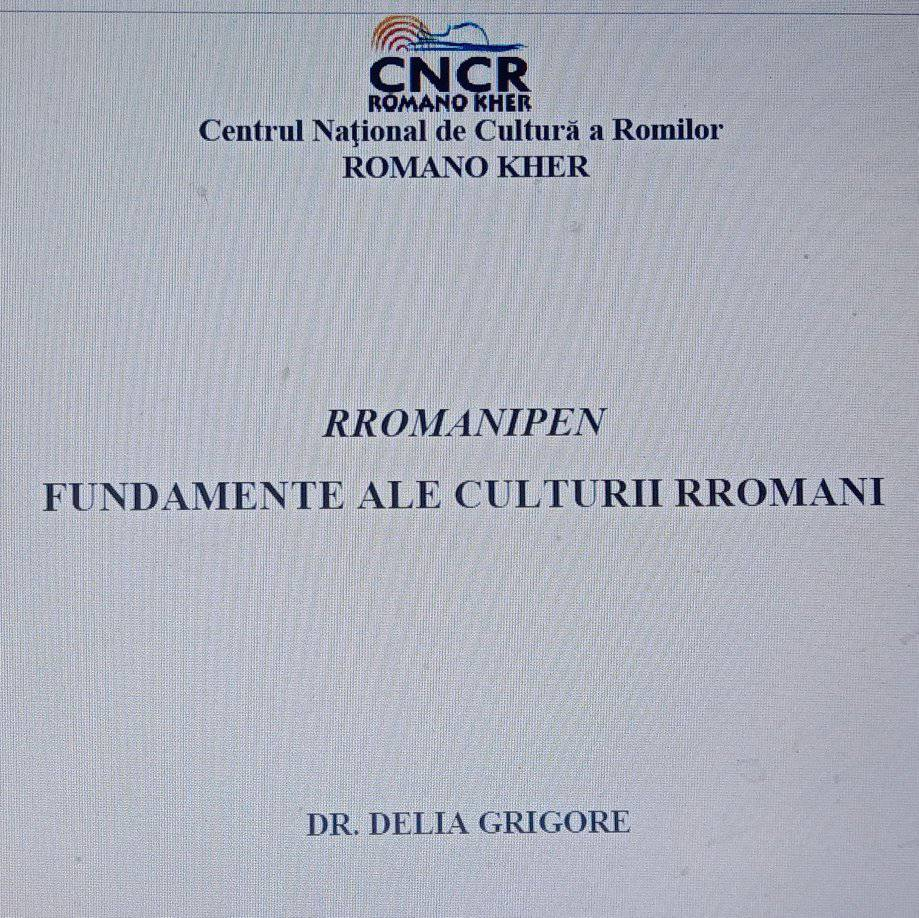
Delia Grigore, wrote in 2011, what I have been saying for about 2 years: that you become ROM - ethnic husband/ROMNI - ethnic wife by marriage, after being born as SHIAVO/SHEI - ethnic son/daughter. The identity of SHIAVO/SHEI remains throughout life, because it is a birth identity, therefore, at weddings, baptisms, judgments, parties, important announcements, any speech addressed to the crowd of gypsies, begins with the formula "SHIAVALEN THAI ROMALEN! " - "TO THE ETHNIC SONS, AND THE ETHNIC SPOUSES!". But Delia Grigore does not tell them these things. The only mistake, INTENTIONAL, is the sneaking, "translation" "our man". RROM is not translated as "ONE OF OUR", but as "ETHNIC HUSBAND". "Our man" is called "MANUSH AMARESTAR", and I have no doubt that Delia Grigore knew how to say it, but she had the goal to somehow spoil the only meaning of the word ROM, in order to put the last, unimportant meaning of ETHNIC HUSBAND, because otherwise, they, the fake ones, could no longer declare themselves. "Regarding the transition from the family of origin / orientation / consanguineous (belonging from birth to marriage) to the family of procreation (starting with the foundation of a new couple), the marriage is made by the consensus of the two "xanamik" (cuscre) families , without the need for an external formalization, by fulfilling the customs that definitively change the status of the two protagonists, including them, only through this ritual act of family creation, among the members of the clan: from "CHAVO" (boy) and "CHAJ" (girl) they become "RROM" (our man, husband, rrom) and "RROMNI" ( our woman, wife, rromni)." Dr. DELIA GRIGORE, RROMANIPEN FOUNDATIONS OF ROMANI CULTURE, CNCR ROMANO-KHER, p. 69 https://www.facebook.com/100058259990461/posts/846072250678100/?app=fbl
Delia Grigore, scria în 2011, ce spun eu de vreo 2 ani: că ROM/ROMNI, devii prin căsătorie, după ce te-ai născut ca SHIAVO/SHEI - fiu/fiică etnic(ă). Identitatea de SHIAVO/SHEI, rămâne de-a lungul vieții, pentru că e identitate de naștere, de aceea, la nunți, botezuri, judecăți, petreceri, anunțuri importante, orice discurs adresat mulțimii de țigani, începe cu formula ”SHIAVALEN THAI ROMALEN!” - ”FIILOR ETNICI, ȘI SOȚILOR ETNICI!”. Dar aceste lucruri Delia Grigore nu le spune. Singura greșeală, INTENȚIONATĂ, este strecurarea, ”traducerii” ”om de-al nostru”. RROM nu se traduce prin ”OM DE AL NOSTRU”, ci prin ”SOȚ ETNIC”. ”Om de-al nostru” se spune ”MANUSH AMARESTAR”, și nu mă îndoiesc că Delia Grigore știa cum se spune, dar avea scopul de a strica cumva unicul sens al cuvântului ROM, pentru ca să pună pe loc ultim, neimportant, sensul de SOȚ ETNIC, pentru că altfel, ei, falșii, nu se mai puteau declara.
”În privinţa trecerii de la familia de origine / de orientare / consangvină (de apartenenţă de la naştere la căsătorie) la familia de procreare (începând cu întemeierea unui nou cuplu), căsătoria se face prin consensul celor două familii „xanamik” (cuscre), fără necesitatea unei oficializări externe, prin îndeplinirea cutumelor care schimbă definitiv status-ul celor doi protagonişti, incluzându-i,
abia prin acest act ritual de creare a familiei, în rândul membrilor neamului: din „CHAVO” (băiat) şi „CHAJ” (fată) ei devin „RROM” (om de-al nostru, soţ, rrom) şi „RROMNI” (femeie de-a noastră, soţie, rromni).”
DR. DELIA GRIGORE, RROMANIPEN FUNDAMENTE ALE CULTURII RROMANI, CNCR ROMANO-KHER, p. 69

P 58:" Many of those interviewed do not accept to live in the same area as Roma and especially reject mixed marriages (Roma - Romanians). On the other hand, the acceptance of inter-ethnic relations is almost unanimous, proving the desire for integration of the Roma"
P 58:” Mulţi dintre cei intervievaţi nu acceptă să locuiască în aceeaşi zonă cu romii şi mai ales resping căsătoriile mixte (romi – români). De cealaltă parte, acceptarea relaţiilor interetnice este aproape unanimă, dovedind dorinţa de integrare a romilor”http://www.edrc.ro/docs/docs/cercetari/Barometrul-incluziunii-romilor.pdf


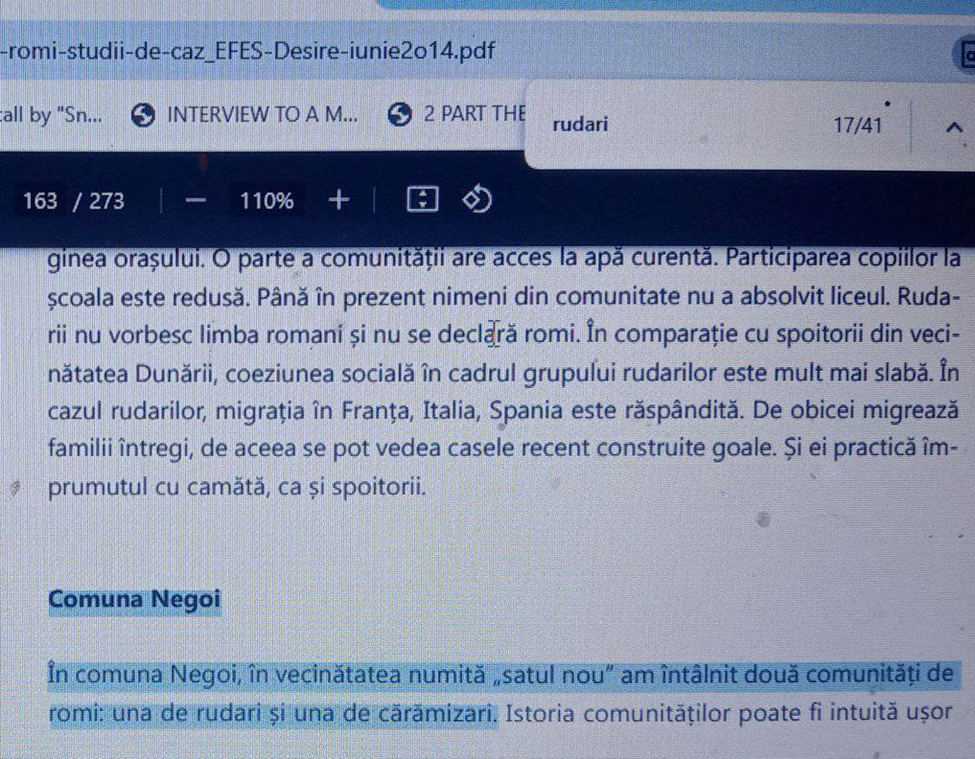
Contradictions written on one page: the Rudarii do not speak the Romani language, and they do not declare themselves Roma, but...the OPERE team of writers (this is what it says on the first page: "The Institute of Cultural Anthropology in Cluj, aims to publish original works" ) declares that the RUDAR are Roma. p.162: "The Rudarii do not speak the Romani language and do NOT declare themselves Roma. Compared to the spoitors from the vicinity of the Danube, the social cohesion within the rudar group is much weaker. In the case of relatives, migration to France, Italy, Spain is widespread. Entire families usually migrate, so you can see recently built houses empty. They too practice usury lending, like the moneylenders. Negoi commune In the Negoi commune, in the neighborhood called "the new village" we met two communities of Roma: one of quarries and one of brickmakers." Case studies in the counties of Alba, Arad, Călărași, Dolj and Iași Authors:#Cătălin Dîrțu, #Adrian-Nicolae Furtună, #Margareta Herțanu, #Iulia-Elena Hossu, #Andrei Tudor MihaiL, #Elena Mihalache, #Rafaela Maria Muraru, #Florina Pop, #Mihaela Preda, #Elena Trifan, #Daniel TUDORA, #Enikő Vincze, Editura Fundaţiei pentru Studii EuropeneCluj, 2014,
”Acest volum a rezultat din faza a doua a cercetării Faces and Causes of Marginalization of the Roma in Local Settings. Contextual inquiry to the UNDP/World Bank/EC Regional Roma Survey 2011, focusing on Hungary, Romania, Serbia. A joint initiative of the United Nations Development Programme (UNDP), the Open Society Foundation’s Roma Initiatives Office (RIO) and the Making the Most of EU Funds for Roma Inclusion program, and the Central European University/Center for Policy Studies (CEU CPS.) Inițiativa a fost finanțată de United Nations Development Programme și de Open Society Foundations.Îngrijită de EFES şi de Institutul de Antropologie Culturală din Cluj, îşi propune publicarea unor opere originale, traduceri, materiale didactice, lucrări de atelier şi conferinţe din domeniul antropologiei culturale, etnologiei Europene, studiilor de gen şi studiilor culturale. Ca atare doreşte să contribuie la instituţionalizarea acestor discipline în România şi la prezentarea rezultatelor cercetărilor culturale şi sociale desfăşurate în Europa de Est post-socialistă.”
Contradicțiile scrise pe o singură pagină: rudarii nu vorbesc limba rromani, și nu se declară romi, dar...echipa de scriitori de OPERE (așa scrie pe prima pagină: ”Institutul de Antropologie Culturală din Cluj, îşi propune publicarea unor opere originale”) declară că RUDARII sunt romi.
p.162: ”Rudarii nu vorbesc limba romani și NU se declară romi. În comparație cu spoitorii din vecinătatea Dunării, coeziunea socială în cadrul grupului rudarilor este mult mai slabă. În cazul rudarilor, migrația în Franța, Italia, Spania este răspândită. De obicei migrează familii întregi, de aceea se pot vedea casele recent construite goale. Și ei practică împrumutul cu camătă, ca și spoitorii. Comuna Negoi În comuna Negoi, în vecinătatea numită „satul nou” am întâlnit două comunități de ROMI: una de rudari și una de cărămizari.”Studii de caz în județele Alba, Arad, Călărași, Dolj și Iași Autori: #Cătălin Dîrțu, #Adrian-Nicolae Furtună, #Margareta Herțanu, #Iulia-Elena Hossu, #Andrei Tudor MihaiL, #Elena Mihalache, #Rafaela Maria Muraru, #Florina Pop, #Mihaela Preda, #Elena Trifan, #Daniel TUDORA, #Enikő Vincze, Editura Fundaţiei pentru Studii EuropeneCluj, 2014,
”Acest volum a rezultat din faza a doua a cercetării Faces and Causes of Marginalization of the Roma in Local Settings. Contextual inquiry to the UNDP/World Bank/EC Regional Roma Survey 2011, focusing on Hungary, Romania, Serbia. A joint initiative of the United Nations Development Programme (UNDP), the Open Society Foundation’s Roma Initiatives Office (RIO) and the Making the Most of EU Funds for Roma Inclusion program, and the Central European University/Center for Policy Studies (CEU CPS.) Inițiativa a fost finanțată de United Nations Development Programme și de Open Society Foundations.Îngrijită de EFES şi de Institutul de Antropologie Culturală din Cluj, îşi propune publicarea unor opere originale, traduceri, materiale didactice, lucrări de atelier şi conferinţe din domeniul antropologiei culturale, etnologiei Europene, studiilor de gen şi studiilor culturale. Ca atare doreşte să contribuie la instituţionalizarea acestor discipline în România şi la prezentarea rezultatelor cercetărilor culturale şi sociale desfăşurate în Europa de Est post-socialistă.”
Rudarii/bă(n)ieșii/ nu acceptă căsătoria cu romii, denumind-o cu dispreț CORCITURĂ
The Rudars/Boyash/Ludars/Kopanars/Kararavlahs do not accept the marriage with the Roma, calling it with contempt CORCITURĂ
Paul-Henri Stahl and Leonardo Piasere, Tre insediamenti di "Rudari" in Romania , La Ricerca Folklorica No. 22, Europa zingara (Oct., 1990), pp. 55-66 (12 pages) Published By: Grafo Spa
”Il matrimonio e endogamo e unisce esclusivamente Rudari con Rudari; la situazione e cosi spiegata: "non vogliamo imbastardirci" (nu se corceste - termine peggiorativo impiegato soprattutto in riferimento agli animali) con gli Zingari. "Se ne sposo una [Zingara], lei non sa fare le scope; non conosce il mestiere". E aggiunge: "ognuno cerca la sua razza" (rasa lui). ”
Paul-Henri Stahl and Leonardo Piasere, Three "Rudari" settlements in Romania, La Ricerca Folklorica No. 22, Gypsy Europe (Oct., 1990), pp. 55-66 (12 pages) Published By: Grafo Spa ”Marriage is endogamous and exclusively unites Rudari with Rudari; the situation is explained thus: "we don't want to bastardize ourselves" (nu se corceste - a pejorative term used especially in reference to animals) with the Gypsies. "If I marry one [Gypsy], she doesn't know how to make brooms; she doesn't know the trade." And he adds: "everyone seeks his own race" (rasa lui).
Paul-Henri Stahl și Leonardo Piasere, Trei așezări „Rudari” în România, La Ricerca Folklorica Nr. 22, Gypsy Europe (oct., 1990), p. 55-66 (12 pagini) Publicat de: Grafo Spa ”Căsătoria este endogamă și unește exclusiv Rudari cu Rudari; situaţia se explică astfel: „nu vrem să ne bastardizăm” (nu se corceste – termen peiorativ folosit mai ales cu referire la animale) cu ţiganii. „Dacă mă căsătoresc cu una [țigancă], ea nu știe să facă mături; nu știe meseria”. Și adaugă: „fiecare își caută propria rasă”.
”Although the Romanian Academy, the Ministry of Education, and other institutions of Romanian culture, knew that under the name "Gypsy" there were many different slaves of different cultural origins in the Romanian Middle Ages, i mean many other races not only Roma with chocolate skin (Africans, Syrians, Egyptians, mention of the Syrian archdeacon Paul of Aleppo , in the 1650s, in the Romanian Countries), who spoke other languages, not the language of the Roma, did not inform these "gypsies" who could be of any origin. The goal was for these people to illegally assume the "Roma identity" in order to ASSIMILATE THE ROMA THROUGH . But the authorities of the Romanian State did not inform them that no one is born ROMA/ROMNI, but only through marriage can become ROMA/ROMNI, an ethnic person, because the words ROMA and ROMNI have only one translation "ETHNIC HUSBAND/ETHNIC WIFE".” Deși Academia Română, Ministerul Educației, și alte instituții ale culturii românești, știau că sub numele de ”țigan” au fost sclavi în Evul Mediu românesc, și alte rase cu pielea ciocolatie (africanii, sirienii, egiptenii, pomeninți de arhidiaconul sirian Paul de Aleppo, în anii 1650, în Țările Române), care vorbeau alte limbi, nu limba romilor, nu i-au informat pe acești ”tsigani” care pot fi de orice origine.Scopul era ca acești oameni să își asume ilegal ”identitatea de rom”. Dar autoritățile Statului Român nu i-au informat că ROM/ROMNI nu se naște nimeni, ci doar prin căsătorie poate deveniROM/ROMNI, o persoană etnică, pentru că cuvintele ROM și ROMNI au o singură traducere ”SOȚ ETNIC/SOȚIE ETNICĂ”. The Chamber of Deputies knew since 2001 that the Rudari are not Roma, that the Rudari think they are DACI, and it is a confusion!
I put the picture I took after the official website of the Chamber of Deputies, and the link of the original pdf with the name em280, with the signatures of the deputies who signed.
"Definitive for an ethnic group, it is the first specific function: the language that its members speak. From this point of view, many population segments are incorrectly classified as Roma. Some of them are fragments of the Dacian truchy, with closed evolution. For example, the loggers, withdrawn into the forests, mainly dealt with wood processing. The Rudars only know the Romanian language, they are Orthodox Christians, they have the Romanian cultic calendar, their ethnoculture (folk costume) is Romanian, etc. They cannot be categorized as Roma since their appearance and developments are totally different. Other population segments are in the same situation as the rudars: spoonmakers, goldsmiths, goldsmiths, boilermakers, blacksmiths, fiddlers, etc... We are all to blame for the current state. The mechanisms of history and the ignorance of Roma problems have created marginalized population segments, including the Roma, with settlements on the periphery of current civilization... Initiator P.R.M Parliamentary Group." http://www.cdep.ro/proiecte/2001/200/80/0/em280.pdf
Camera deputaților știa din 2001 că rudarii nu sunt romi, că rudarii se cred DACI, și este o confuzie!
Pun doar poza făcută de mine după site-ul oficial al Camerei Deputaților, și linkul pdf-ului original cu numele em280, cu semnăturile deputaților care au semnat.
”Definitoriu pentru un grup etnic, este prima funcție specifică: limba pe care o vorbesc membrii lui. Din acest punct de vedere multe segmente populaționale sunt incorect încadrate în etnia romilor. Unele dintre ele sunt spărturi din truchiul dacic, cu evoluție închisă. De exemplu, rudarii, retrași în păduri, s-au ocupat în principal, cu prelucrarea lemnului. Rudarii cunosc numai limba română, sunt creștini ortodocși, au calendarul cultic românesc, etnocultura lor (costumul popular) este românească, etc. Ei nu pot fi categorisiți drept romi din moment ce apariția și evoluțiile lor sunt total diferite. În aceeași situație ca a rudarilor se află și alte segmente populaționale: lingurarii, aurarii, zlătarii, căldărarii, fierarii, lăutarii, etc…De starea actuală suntem vinovați cu toții. Mecanismele istoriei și ignorarea problemelor romilor au creat segmente populaționale, printre care și romii, marginalizate, cu așezări aflate la periferia civilizației actuale….Ințiator Grupul Parlamentar P.R.M.” http://www.cdep.ro/proiecte/2001/200/80/0/em280.pdf

The confusion also reached the official censuses, in NELM In NELM, at the 2011 Census, RUDARII, BĂIEȘII, plus CASTAL were declared Roma (ethnically married). There is no Roma group called CASTAL. The Roma call the Rudars/Boyash KASHTALE – woodworkers.
Confuzia a ajuns și la recensămintele oficiale, în NELM În NELM, la Recensământ 2011, au fost declarați romi (căsătoriți etnic) RUDARII, BĂIEȘII, plus CAȘTAL. Nu există nici un grup rom să se numească CAȘTAL. Romii le zic rudarilor/băieșilor KASHTALE – lemnari.

So the Chamber of Deputies, the Government of Romania, knew from 2001 that the Rudari declare themselves Dacians, not Roma. Who then wanted, and WHY, to declare them Roma? The Romanian Government National Center for Roma Culture CNCR Romano-Kher answers us, through the project "HERITAGE FROM HERITAGE I DID THIS JOB. TRADITIONAL ROMA CRAFTS: ECONOMIC REALITIES AND IDENTITY CONSTRUCTION - socio-anthropological study Romano-Cher project: Roma House POSDRU/84/6.1/S/56327 February 2011, p. 16:
"The purpose of the discussion that we will detail in this study is not the elucidation of the myth of the origins of the Rudars, but rather its deconstruction and the placing in perspective of the works on this theme."
P. 186: "We will show, among many others, how the Rudarii invest their products with an authenticity built on the identity narrative of descendants of the Dacians..." P. 196: "It is very possible in the case of this community that the strategy to continue self-identification with the Rudari race is in fact a strategy to separate them from other Roma races, and an attempt to blur the borders between Roma and Romanians, relying on the myth of proto-origin - Dacians of Rudars/Boyash, which those from Pietrișu introduce in their identity discourse."
Deci Camera Deputaților, Guvernul României, știau din 2001 că rudarii se declară daci, nu romi. Cine atunci voia, și DE CE , să-i declare romi? Ne răspunde GUVERNUL ROMÂNIEI Centrul Național de Cultură a Romilor CNCR Romano-Kher, prin proiectul ” MOŞTENITURĂ DIN MOŞTENITURĂ AM FĂCUT MESERIA ASTA. MEŞTEŞUGURILE TRADIŢIONALE ROME: REALITĂŢI ECONOMICE ŞI CONSTRUCŢII IDENTITARE -studiu socio-antropologic proiect Romano-Cher: Casa Romilor POSDRU/84/6.1/S/56327 februarie 2011, p. 16: ”Scopul discuţiei pe care o vom detalia în acest studiu nu este elucidarea mitului originilor la rudari, ci mai degrabă deconstrucţia acestuia şi plasarea în perspectivă a lucrărilor pe această temă.” P. 186: ”Vom arăta, printre multe altele, cum rudarii îşi învestesc produsele cu o autenticitate construită pe naraţiunea identitară de descendenţi ai dacilor,…”P. 196: ” Este foarte posibil în cazul acestei comunităţi ca strategia de a continua autoidentificarea cu neamul rudarilor să fie de fapt o strategie de departajare de alte neamuri de romi, şi o încercare de a estompa graniţele dintre romi şi români, mizând pe mitul originii proto-dacice a rudarilor, pe care cei din Pietrişu îl introduc în discursul lor identitar.”
P. 211: "5.3.1. Again, the Rudarii: a special case "We are different" A singular case in terms of efforts to rebuild and an ancestral tradition producing authenticity is the Rudarii. They refer to their ethnic origin, supposedly Dacian, and to the fact that the craft of woodworking was taken over from the Dacians and kept intact to this day. In particular, the members of the Rudari community from Băbeni believe that an element of their specificity is the Dacian tradition, which they feel obliged to preserve and promote further. The Rudarii perceive themselves as exponents of the authentic, "traditional" Romanian peasant. In the opinion of the rudars from the Băbeni community, the craft of rudarît is one that starts from the traditional needs of the peasant: "Our job is linked only to the warm hearth of the Romanian peasant." Although it would be possible to process some pieces on the wooden lathe, the miners refuse to modernize their means of production, because it would break away from the Dacian tradition, in which only simple, rudimentary metal tools and wooden tails are used: Everything it is done with Dacian tools, no machines are used. Since we've known each other, we've only worked with these (V.L., cousin, Babeni)."
P. 211: ” 5.3.1. Din nou, rudarii: un caz aparte „Noi suntem altfel” Un caz singular în ceea ce privește eforturile de a reconstrui şi o tradiţie ancestrală producătoare de autenticitate îl constituie rudarii. Aceştia fac referinţă la originea lor etnică, presupusă dacică, şi la faptul că meşteşugul prelucrării lemnului a fost preluat de la daci şi păstrat intact până în zilele noastre. În special membrii comunităţii de rudari din Băbeni consideră că un element de specificitate a lor este tradiţia dacică, pe care se simt datori să o păstreze şi promoveze mai departe. Rudarii se percep ca fiind exponenţii ţăranului român autentic, „tradiţional”. În opinia rudarilor din comunitatea Băbeni, meşteşugul rudăritului este unul care porneşte de la nevoile tradiţionale ale ţăranului: „Meseria noastră este legată numai de vatra caldă a ţăranului român.” Deşi ar exista posibilitatea prelucrării unor piese la strungul de lemn, rudarii refuză să-şi modernizeze mijloacele de producţie, pentru că s-ar desprinde de tradiţia dacică, în care sunt utilizate doar instrumente simple, rudimentare, din metal şi cozi din lemn: Totul se face cu instrumente dacice, nu se folosesc utilaje. De când ne ştim, noi numai cu astea am lucrat (V.L., rudăreasă, Băbeni).”
Here you can dowload the pdf of the Project of reconstruction of the Rudar Dacian identity as FAKE ROMA:
Romano-Cher project: Roma House POSDRU/84/6.1/S/56327 HUGE AMOUNTS OF MONEY
Burcea Ştefan Gabriel: University lecturer, tenured teaching staff within the Department of Administration and Public Management, Vice-Dean responsible for teaching activity, Trainer for Social Entrepreneurship courses, Communication and Public Relations Assistant and Sales Agent within the "Romano Cher - House of Roma" project (POSDRU/84/6.1/S/56327 – beneficiary: K.C.M.C.), financed from the Sectoral Operational Program Human Resources Development 2007 – 2013 (May 2011 – September 2012) https://resurseumane.ase.ro/wp-content/uploads/ 2022/01/AMP-conference-13-Burcea-Stefan-cv.pdf
https://www.cncd.ro/wp-content/uploads/2021/02/cv_OLTEANU.pdf
Catalina Olteanu 01/07/2010-01/05/2013 Project assistant within the project "Romano Cher - Roma House" financed POSDRU/84/6.1/S/56327 99 R POSDRU/84/6.1/S/56327 21445 SC K Consulting Management and Coordination SRL 9 31/05/2013 27/06/2013 3,710,222.92 https://www.oirposdrucentru.ro/wp-content/uploads/2015/02 /Registrul_CR.pdf
https://www.fonduri-structurale.ro/Document_Files/Stiri/00009391/3dwf4_plati_4_mai_23_iunie_2011.pdf
124 R POSDRU/84/6.1/S/56327 SC K Consulting Management and Coordination SRL 2,380,597.78 05/13/2011 125 R POSDRU/84/6.1/S/56327 SC K Consulting Management and Coordination SRL 1 499,738.31 13.05.2011
Romano-Cher project: Roma House POSDRU/84/6.1/S/56327 SUME URIAȘE
Burcea Ştefan Gabriel: Lector universitar, cadru didactic titular în cadrul Departamentului de Administraţie şi Management Public, Prodecan responsabil cu activitatea didactic, Formator pentru cursurile de Antreprenoriat Social, Asistent Comunicare şi Relaţii Publice şi Agent Vânzări în cadrul proiectului „Romano Cher – Casa Romilor” (POSDRU/84/6.1/S/56327 – beneficiar: K.C.M.C.), finanţat din Programul Operaţional Sectorial Dezvoltarea Resurselor Umane 2007 – 2013 (Mai 2011 – Septembrie 2012)
Cătălina Olteanu
01/07/2010-01/05/2013 Asistent de proiect în cadrul proiectului ”Romano Cher – Casa Romilor” finanțat POSDRU/84/6.1/S/56327 99 R POSDRU/84/6.1/S/56327 21445 SC K Consulting Management and Coordination SRL 9 31/05/2013 27/06/2013 3,710,222.92 https://www.oirposdrucentru.ro/wp-content/uploads/2015/02/Registrul_CR.pdf https://www.fonduri-structurale.ro/Document_Files/Stiri/00009391/3dwf4_plati_4_mai_23_iunie_2011.pdf
124 R POSDRU/84/6.1/S/56327 SC K Consulting Management and Coordination SRL 2.380.597,78 13.05.2011 125 R POSDRU/84/6.1/S/56327 SC K Consulting Management and Coordination SRL 1 499.738,31 13.05.2011
In other words, the CNCR Romano-Kher DECONSTRUCTS THE MYTH OF THE DACIC ORIGIN of the Rudaris, and declares them Roma, against their will. The same thing is written by Marcel Courthiade, the head of the doctrine of the NGO IRU/Romani Unia, adopted by the University of Bucharest:
Cu alte cuvinte, CNCR Romano-Kher, DECONSTRUIEȘTE MITUL ORIGINII DACICE al rudarilor, și îi declară romi, contrar voinței lor. Același lucru îl scrie și Marcel Courthiade, șeful doctrinei ONG IRU/Romani Unia, adoptată de Universitatea București:
Marcel Courthiade talks in the footer of his article, posted on his blog, about the ROMANIAN (not the Romani language, an Indian one) language of the Rudars, and admits that they have been Latinized for a long time, but he ADMITS that he uses CONFUNDARE ("confusing") them with Roma, by translating the word GYPSIES into politically correct language with ROM. This translation is historically FALSE, as not all Gypsies were Roma:
”1 This is a probably autochthonous population from Upper Moesia (today South Serbia), already Latinized before our era and who went to work in Muntenia (and later a part in Transylvania and Moldova) in the Middle Ages. Being a foreigner, she passed there after a long fiscal-feudal process to the status of slaves, i.e. "gypsies", just like the Rroma - a fact that caused their frequent confusion with the Rroma, especially lately in administrative and political texts. In Romania, they quickly lost their language, very similar to the Banatian Romanian dialect, but it is preserved purely in Croatia (Jupania de Ciakoveţ) and Hungary. We find their communities in Bulgaria, Bosnia, Greece, Mexico, Chile and Colombia. Their speech, so beautiful and poetic, is in danger of disappearing due to authoritarian policies that will impose on them, against their feelings and wishes, a Romani identity."
Marcel Courthiade vorbește în subsolul articolului său, postat pe blogul său, despre limba ROMÂNEASCĂ a rudarilor, și recunoaște că ei sunt latinizați de mult, dar el RECUNOAȘTE că se folosește de CONFUNDARE (”confuderea”) lor cu romii, prin traducerea cuvântului ȚIGAN în limbaj politic corect cu ROM. Această traducere este FALSĂ din punct de vedere istoric, căci nu toți țiganii au fost romi:
”1 Este vorba de o populaţie probabil autohtonă din Moesia superioara (astăzi Sârbia de Sud), latinizată deja înainte de era noastră şi care s-a dus în Evul Mediu la munca în Muntenia (şi o parte mai târziu în Ardeal şi Moldova). Fiind străină a trecut acolo după un proces fiscalo-feodal lung la statut de robii, adică „ţăgani”, la fel ca Rromii – fapt ce a pricinuit confuderea lor frecventă cu Rromii, mai ales în ultimul timp în textele administrative şi politice. În România, au pierdut repede graiul lor, foarte asămănator cu dialectul român banaţean, dar se pastrează pur în Croaţia (jupania de Ciakoveţ) şi Ungaria. Găsim comunautăţi lor în Bulgaria, Bosna, Grecia, Mexico, Chile şi Colombia. Graiul lor aşa de frumuşel şi poetic se află în pericol de dispariţie din cauza politici autoritare care le vor impune, împotriva simţitului şi dorinţi lor, o identitate rromani.”

Sursa imagine, articolul pdf de pe siteul lui Marcel Courthiade: http://marcel-online.carlod.fr/wp-content/uploads/2012-RO-Saracagoala.pdf
Marcel Courthiade's motives are diabolical, as is his method of deceiving two different ethnicities: the Roma and the Rudarii. The fragments quoted above are from the article "Rromani - a poor and empty language", published in "Rrom or Țigan, dilemmas of an ethnonym...", under the auspices of the Government of Romania. In reality, the ORIGINAL ARTICLE (in the book "Rrom or Gypsy...", Marcel Courthiade did not insert these fragments revealed here), in the pdf, Marcel Courthiade admits that those Rudars are...Romanians, non-Roms. Basically, Marcel Courthiade himself attacks the Romanian language, the mother tongue of the Romanians (Rudars), because he forced them, he and the NGO IRU, and the University of Bucharest, to forget the fact that their mother tongue is Romanian Latin, lying to them that their mother tongue is the Romani Indian language! NOBODY imposed a Romani identity (linguistic identity!) on the Rudaris, but he himself, and his NGO IRU, through Gheorghe Sarau and Delia Grigore. That the website http://marcel-online.carlod.fr/ really belongs to Marcel Courthiade can be verified on google books, in the bibliography of the doctoral work of the student of Marcel Courthiade and Gheorghe Sarau, Mr. Cristian Tudor Pădure:
Motivele lui Marcel Courthiade sunt diabolice, ca și metoda lui de a înșela două etnii diferite: romii și rudarii. Fragmentele citate mai sus sunt din articolul ”Rromani – o limbă săracă și goală”, apărut în ”Rrom sau Țigan, dilemele unui etnonim…”, sub aureola Guvernului României. În realitate, ARTICOLUL ORIGINAL (în cartea ”Rrom sau Țigan…”, Marcel Courthiade nu a introdus aceste fragmente dezvăluite aici), în pdf, Marcel Courthiade recunoaște că acei rudari sunt…români. Practic, Marcel Courthiade însuși atacă limba română, limbă maternă a rudarilor, căci el îi obliga, el și ong IRU, și Universitatea București, să uite faptul că limba lor maternă este limba română/latină, mințindu-i că limba lor maternă este limba rromani/indiană! Nu le-a impus NIMENI o identitate rromani (identitate lingvistică!) rudarilor, ci chiar el însuși, și ong-ul său IRU, prin Gheorghe Sarău și Delia Grigore. Că siteul http://marcel-online.carlod.fr/, aparține cu adevărat lui Marcel Courthiade, se poate verifica și pe google books, în bibliografia lucrării de doctorat a studentului lui Marcel Courthiade și Gheorghe Sarău, domnul Cristian Tudor Pădure:


”https://editura-unibuc.ro/magazin/colectii/colectia-lci-limbi-culturi-identitati/la-variation-copule-clitique-sujet-en-romani-du-mexique-au-contact-de-ser-et-estar-de-lespagnol/
LA VARIATION COPULE/CLITIQUE SUJET EN ROMANI DU MEXIQUE AU CONTACT DE SER ET ESTAR DE L’ESPAGNOL Autor: CRISTIAN TUDOR PADURE An aparitie: 2021 Numar de pagini: 252 Format: B5 ISBN: 978-606-16-1220-8 Limba textului: franceză 29,00 lei Această teză vizează studiul alternanței din varietatea romani mexicană a copulei si cu cliticele substantivale -lo; -li/-la; -le.”
Saimir Mile writes, in a book edited by Valeriu Nicolae, that in Croatia, the Rudar/Boyash say: "we have nothing in common with those who sing Gelem Gelem."
In Saimir Mile's article, "The Result of a Forced Naturalisation Under the Pressure of Politically Correct Vocabulary", published in the book "Roma Diplomacy", editor Valeriu Nicolae, p. 160: "in Croatia, for example, people from Beas often say "we have nothing to do with those who sing "Gelem, gelem [Romani hymn]". The government seems to have changed its position on minority identification and plans to introduce the 'Beas' option in the questionnaires for the next census (personal communication, Dr M. Courthiade)."
Saimir Mile, scrie, într-o carte editată de Valeriu Nicolae , că în Croația, ”țiganii” ne-romi băieși spun: ”noi nu avem nimic în comun cu cei care cântă Gelem Gelem.”
În articolul lui Saimir Mile,”The Result of a Forced Naturalisation Under the Pressure of Politically Correct Vocabulary”, publicat în cartea ”Roma Diplomacy”, editor Valeriu Nicolae, p. 160: ” în Croația, de exemplu, oamenii din Beas spun adesea „nu avem nimic de-a face cu cei care cântă „Gelem, gelem [imnul Rromani] ”. Guvernul pare să-și fi schimbat poziția în ceea ce privește identificarea minorităților și intenționează să introducă opțiunea „Beas” în chestionarele pentru următorul recensământ (comunicare personală, dr. M. Courthiade).”
In Saimir Mile's article, "The Result of a Forced Naturalisation Under the Pressure of Politically Correct Vocabulary", published in the book "Roma Diplomacy", editor Valeriu Nicolae, p.160, we read:
"Since Tsigan or Gypsies are not a people, but a social group that brings together various peoples stigmatized by the majority population, it is nonsense to think of a Gypsy language. It is also nonsense, and shows contempt for other languages and cultures, to use the term Rromani as the politically correct translation of the word Gypsy, and consequently to talk about "Rromani languages", in order not to discriminate. Here we run into the real problem, one that manifests itself in two different ways. Either nation-states refuse to recognize national identities other than those they have created by voluntarily confusing citizenship with nationality; or, recognizing in principle such national identities, states refuse to apply this notion to Roma or other peoples who do not have their own state."
From the same article by Saimir Mile, edited by Valeriu Nicolae, published in the book "Roma Diplomacy", published in 2007 by The International Debate Education Association, International Debate Education Association New York – Amsterdam – Brussels DiploFoundation Malta – Geneva Policy Center for Roma and Minorities Bucharest, p. 159: "The hypothesis that the Boyash are a group of Roma who abandoned their language fails once the observer registers the presence of a language different from both Roma and other surrounding languages (in this case, Croatian and Hungarian) and the non-recognition of the language Romani as a lost language among the population of Băiași".
About Valeriu Nicolae: In 2015 and 2016, he was a member of the Prime Minister's Chancellery and State Secretary in the Ministry of Labor in the Dacian Cioloș Government. At the same time, he was a member of the board of directors of the UN High Commissioner for Human Rights. He was Special Representative of the Secretary General of the Council of Europe for Roma Affairs between 2016 and 2017. https://ro.wikipedia.org/wiki/Valeriu_Nicolae Valeriu
În articolul lui Saimir Mile,”The Result of a Forced Naturalisation Under the Pressure of Politically Correct Vocabulary”, publicat în cartea ”Roma Diplomacy”, editor Valeriu Nicolae, p.160, citim:
”Întrucât țiganii sau Gypsies nu sunt un popor, ci un grup social care reunește diverse popoare stigmatizate de populația majoritară, este un nonsens să ne gândim la o limbă a țiganilor. Este, de asemenea, un nonsens, și arată dispreț pentru alte limbi și culturi, să folosești termenul rromani ca traducere politică corectă a cuvântului țigan și, în consecință, să vorbim despre „limbi rromani”, pentru a nu discrimina. Aici ne confruntăm cu adevărata problemă, una care se arată în două moduri diferite. Fie statele-națiune refuză să recunoască identități naționale diferite de cele pe care le-au creat prin confundarea voluntară a cetățeniei cu naționalitatea; sau, recunoscând în principiu asemenea identități naționale, statele refuză să aplice această noțiune romilor sau altor popoare care nu au un stat propriu.”
Din același articol al lui Saimir Mile, editat de Valeriu Nicolae, publicat în cartea "Roma Diplomacy”, publicată în 2007 de The International Debate Education Association, International Debate Education Association New York – Amsterdam – Brussels DiploFoundation Malta – Geneva Policy Center for Roma and Minorities Bucharest, p. 159: „Ipoteza conform căreia Băieșii ar fi un grup de rromi care și-au abandonat limba, eșuează odată ce observatorul înregistrează prezența unei limbi diferite atât de rromani, cât și de alte limbi din jur (în acest caz, croată și maghiară) și nerecunoașterea limbii rromani ca limba pierdută în rândul populației de Băiași”.
About Valeriu Nicolae: In 2015 and 2016, he was a member of the Prime Minister's Chancellery and State Secretary in the Ministry of Labor in the Dacian Cioloș Government. At the same time, he was a member of the board of directors of the UN High Commissioner for Human Rights. He was Special Representative of the Secretary General of the Council of Europe for Roma Affairs between 2016 and 2017. https://ro.wikipedia.org/wiki/Valeriu_Nicolae Valeriu
In the following lines, Gheorghe Sarau openly admits that the University of Bucharest chose NON-ROMAs, in order to build a false Roma identity for them, on the principle that they lost their Romani language, although Gheorghe Sarau wrote in his book "Rromii, India, and the Romani language, "Kriterion publishing house, 1998, that "under the name of Gypsies there could be other races, not only Roma":
"At the same time, the question arose: why was there a need for a young Roma intelligentsia, given that, in the society after 1990, there were Roma specialists for almost all fields, trained since communism? For the simple fact that many of them, educated in the spirit of "society homogenization", were, against their will, the victims of erasing their own fundamental ethnic landmarks (Romani language, Romani history and traditions, common Romani ethnic consciousness, etc.), which caused that many no longer perceive the new change and no longer feel rromanes, meaning "in a rroma way". This required, on the part of the Rroma intellectuals, a quick and visible connection to the new Rroma ethnic context, which would "graft", spiritually and militantly, on the ancient Rroma ethnic roots, their new aspirations and ethnic constructs, including the Rroma linguistic reconstruction. If, after the events of December 1989, some people needed a few seconds to "relive the romance", others, maybe a few minutes or tens of minutes, some an hour or a few hours, others a day or several days, in some cases it may have taken a week or weeks, months or years, unfortunately. For some, however, it was expected that they would not have the courage (and they still don't have it!) to publicly assume their Roma identity! This thing was and is still visible among many Roma specialists, artists and Roma teachers, who in the fight with themselves do not manage to deconstruct their self-stigma, to cross the barrier towards the many, thus undressing of the unpleasant burden of the "gypsy" stigma, and campaigning, in the "daylight", for the promotion of the romanipen, of the set of fundamental values of the Roma - in the most fortunate case suspected by the pledges or insufficiently known. This is why the new contingent of Roma intellectuals was needed, to be formed in the new society without the Roma ethnic complex, with the desire and the fact to develop the fundamental Roma values, including rediscovering them, appropriating them, keep them and pass them on." WORKSHOP STUDIES. RESEARCH ON NATIONAL MINORITIES IN ROMANIA WORKING PAPERS IN ROMANIAN MINORITY STUDIES, Gheorghe Sarău "History of the study of the Romanian language and the schooling of the Roma in Romania (1990–2012), Institute for the Study of National Minority Problems Cluj-Napoca, 2013. https://www.ispmn .gov.ro/uploads/51d17342-8324-4e7d-b7a4-41484e604109-WP46%2520cor.pdf
În rândurile următoare, Gheorghe Sarău recunoaște deschis că Universitatea București și-a ales NE-ROMI, pentru a le contrui o falsă identitate romă, pe principiul că și-au pierdut limba rromani, deși Gheorghe Sarău scria în cartea sa ”Rromii, India , și limba rromani, ”editura Kriterion, 1998, că ”sub numele de țigani puteau fi și alte rase, nu numai romii”:
”În acelaşi timp, se punea întrebarea: de ce era nevoie de o tânără intelectualitate rromă, în condiţiile în care, în societatea de după 1990, existau specialişti rromi pentru aproape toate domeniile, formaţi încă din comunism? Pentru simplul fapt că foarte mulţi dintre aceştia, educaţi în spiritul „omogenizării societăţii”, au fost, fără voia lor, victimele ştergerii propriilor repere etnice fundamentale (limba rromani, istoria şi tradiţiile rrome, conştiinţa etnică rromă comună etc.), ceea ce a făcut ca mulţi să nu mai perceapă noua schimbare şi să nu mai simtă rromanes, adică „în manieră rromă”. Aceasta necesita, din partea intelectualilor rromi, o racordare rapidă şi vizibilă la noul context etnic rrom, care să „grefeze”, spiritual şi militant, pe străvechile rădăcini etnice rrome, noile lor aspiraţii şi constructe etnice, inclusiv reconstrucţia lingvistică rromani. Dacă, după evenimentele din decembrie 1989, unora le-au trebuit câteva secunde ca să „retrăiască rromanes”, altora, poate, câteva minute ori zeci de minute, unora, o oră sau câteva ore, altora, o zi sau mai multe zile, în unele cazuri a fost, poate, nevoie de o săptămână ori de săptămâni, de luni ori de ani, din păcate.Pentru unii însă era de aşteptat că nu vor avea curajul (şi nici acum nu-l au!) de a-şi asuma, public, identitatea rromă! Lucrul acesta a fost şi este vizibil încă în rândul multor specialişti rromi, al artiştilor şi al profesorilor rromi, care în lupta cu ei înşişi nu reuşesc să-şi deconstruiască stigma de sine, să treacă bariera spre cei mulţi, dezbrăcându-se, astfel, de încărcătura neplăcută a stigmatului de „ţigan”, şi militând, la „lumina zilei”, pentru promovarea rromanipenului, a ansamblului de valori fundamentale ale rromilor – în cel mai fericit caz bănuit de gajei ori insuficient cunoscut. Iată de ce era nevoie de noul contingent de intelectuali rromi, care să fie format în noua societate fără complexul de etnic rrom, cu dorinţa şi fapta de a dezvolta valorile rrome fundamentale, inclusiv de a le redescoperi, de a şi le apropria, de a le păstra şi de a le transmite mai departe.” STUDII DE ATELIER. CERCETAREA MINORITĂŢILOR NAŢIONALE DIN ROMÂNIA WORKING PAPERS IN ROMANIAN MINORITY STUDIES, Gheorghe Sarău ”Istoricul studiului limbii rromani şi al şcolarizării rromilor în România (1990–2012), Institutul pentru Studierea Problemelor Minorităţilor Naţionale Cluj-Napoca, 2013. https://www.ispmn.gov.ro/uploads/51d17342-8324-4e7d-b7a4-41484e604109-WP46%2520cor.pdf

But here is how the same Gheorghe Sarău recommends on page 68 (Gheorghe Sarău, Elena Radu, Guide to the school mediator for Roma communities, Bucharest, 2011) for school mediators to assume the "Roma" identity:
"For X-raying the children's ethnic identity, do not ask them, talk with the mothers, with the parents, individually, explain to them the new context of open acceptance of identity, the measures to increase self-esteem, the need to deconstruct the stigma of self etc."
On page 123, Gheorghe Sarau urges school mediators to entice non-Roma citizens to declare themselves Roma because they have opportunities:
"It is informed and trained, including in the language of the respective community, regarding the educational facilities and opportunities intended for children and young people and ensures the propagation of this information to all children, young people and their families in the respective community."
Dar, iată cum recomandă la pag. 68 (Gheorghe Sarău, Elena Radu, Ghidul mediatorului școlar pentru comunități cu rromi, București, 2011) mediatorilor şcolari acelaşi Gheorghe Sarău ca să fie asumată identitatea „rromă”:
„Pentru radiografierea identităţii etnice a copiilor, nu-i întrebaţi pe ei, discutaţi cu mamele, cu părinţii, în mod individual, explicaţi-le contextul nou de asumare deschisă a identităţii, a măsurilor pentru creşterea stimei de sine, a necesităţii deconstruirii stigmei de sine etc.”
La pagina 123, Gheorghe Sarău îndeamnă mediatorii școlari să îi ademenească pe cetățenii ne-romi să se declare romi pentru că au oportunități:
”Se informează și se instruiește inclusiv în limba comunității respective, cu privire la facilitățile și oportunitățile educaționale destinate copiilor și tinerilor și asigură propagarea acestor informații către toți copii, tinerii și familiile acestora din comunitatea respectivă.”
Gheorghe Sarău does not explain to those non-Roma "Gypsies" that they cannot assume Roma, but must be born Shiave, and marry Sheya, to become ROMA and ROMNI.
Gheorghe Sarău nu explică acelor ”țigani” neromi că nu se pot asuma rom, ci trebuie să se nască shiave, și să se căsătorească cu sheya, pentru a deveni ROM și ROMNI.
Gheorghe Sarau knew from Marcel Courthiade, his mentor, that the Rudari are not Roma, but Egyptian. Knowing that the Rudari were not Roma, the only way of re-Romaization was the marriage of the Rudari with the Roma, through the "brainwashing" program run by the Ministry of Education, of "reconstruction of the Roma identity" by "learning the Romani language", as he said Nicolae Gheorghe:
"We are trying to enable, to rebuild such a public, institutionalized identity, through the practice associated with the policy for national minorities, BY TEACHING THE ROMANIAN LANGUAGE in some classes/schools, through quotas reserved for Roma in high school education or some colleges, etc.; this process may take another 10 years, or 20 years..., maybe it will succeed, maybe it won't; what is clear for my understanding is that the ROMA IDENTITY WAS KEPT BY THE CLAN, according to a certain type of marriage, according to certain rules, which may be of kinship, of exchanges between families, etc. SO YOU CAN'T BE ROMA ANYWAY, JUST BECAUSE YOU WANT TO." (Vasile Ionescu, Pakiv Solah... p 445.)https://ikultura.ro/biblioteca/pakiv-solah-testamentul/
Gheorghe Sarău știa de la Marcel Courthiade, mentorul său, că rudarii nu sunt romi, ci egipteni. Știind că rudarii nu au fost romi, singura modalitate de reromizare era căsătoria rudarilor cu romii, prin programul de ”spălare pe creier”, derulat de Ministerul Educației, de ”reconstrucție a identității romi” prin ”învățarea limbii romani”, așa cum a zis Nicolae Gheorghe:
”Noi încercăm să abilităm, să reconstruim o astfel de identitate publică, instituționalizată, prin practica asociată politicii pentru minorități naționale, PRIN PREDAREA LIMBII ROMANI în unele clase/școli, prin cotele rezervate pentru romi în învățământul liceal sau unele colegii etc; procesul ăsta poate va dura încă 10 ani, sau 20 de ani…, poate va reuși, poate nu va reuși; ceea ce este clar pentru înțelegerea mea este că IDENTITATEA DE ROM A FOST PĂSTRATĂ DE CLAN, după un anumit tip de mariaj, după anumite reguli, care pot fi de rudenie, de schimburi între familii, etc. DECI NU POȚI SĂ FII ROM ORICUM, NUMAI PENTRU CĂ VREI.” (Vasile Ionescu, Pakiv Solah… p 445.)https://ikultura.ro/biblioteca/pakiv-solah-testamentul/

The diplomat Weerendra Raj Rishi, the supreme head of the IRU (the doctrine of the NGO IRU/ROMANI UNIA, was adopted as the doctrine of the University of Bucharest), the one who financed the creation of the IRU with money from the Government of India and Indira Gandhi, knew that not all GYPSIES/GYPSIES from Europe is Roma. He said in his book "Roma", p. 9, 1996, that: "No connection with the so-called "Gypsies" of India. Whenever someone talks about the Romas of Europe etc..., some connect them with the so-called Indian Gypsies from whatever part of India they live. The word "gypsy" used in connection with the gypsy/gypsy tribes of India in its pure and conventional sense means "nomad", and should not be understood in any way to be related to the Romanies of Europe etc... All over India there are nomadic castes or tribes that resemble gypsies in their way of life, customs, trades, and characteristics, but they use the dialects of the districts where they come from or where they are located. They all speak secret languages totally different from each other - invented jargons of many varieties, in no way resembling the Romani language. Similarly, all "Gypsies" in Europe are not Romani, because Romani are from Punjab, they all have Punjabi culture and Indian appearance, and they all speak Romani, which is a Punjabi language."
Vanko Rouda, a spus aceste lucruri, deși șeful său suprem, diplomatul Weer Rishi, creatorul ong IRU, a scris clar că nu toți țiganii din Europa sunt romi. Diplomatul Weerendra Raj Rishi, supremul șef IRU (doctrina ong IRU/ROMANI UNIA, a fost adoptată ca doctrină a Univeristății București) , cel ce a finanțat crearea IRU cu bani de la Guvernul Indiei și Indira Gandhi, știa că nu toți GYPSIES/ȚIGANII din Europa sunt romi. El spunea în cartea sa ”Roma”, p. 9, 1996, că: ”Nici o conexiune cu așa-denumiții ”Gypsies” ai Indiei. Ori de câte ori cineva vorbește despre Romii Europei etc…, câte unii îi conectează cu așa-zișii Gypsies din India din orice parte a Indiei ar trăi aceștia. Cuvântul ”gypsy” folosit în legătură cu triburile țigănești/gypsy din India în sensul său pur și conventional înseamnă ”nomad”, și nu trebuie înțeles sub nici o formă ca având legătură cu Romii din Europa etc… Peste tot în India sunt caste nomade sau triburi care seamană cu gypsies/țiganii privind modul lor de viață, obiceiuri, meserii, și caracteristici, dar ei folosesc dialectele districtelor de unde vin sau unde ei se află. Toți vorbesc limbi secrete diferind total unele de altele – jargoane iventate de soiuri multe, neasemănându-se sub nici o formă cu limba Romani. Similar, toți ”țiganii” din Europa nu sunt romi, pentru că romii provin din Punjab, toți au cultură Punjabi și înfățișare de indieni, și toți vorbesc Romani, care este o limbă Punjabi.”

Marcel Courthiade: "CONFUNDE ET IMPERA"
Marcel Courthiade therefore knew that the Rudarii were of Egyptian origin, and that they were not Roma, but according to another article signed by Courthiade, he and the Romani department of the Univ. Bucharest call them "Rroma" artificially, for conspiratorial purposes against Roma and Romanians. I took the exam at the Romance language section of the University of Bucharest in 2004, and Marcel Courthiade, the head of the doctrine taught at the Romance language department, published this article in 2003, in which he clearly wrote that the Rudari, the Egyptians, the Ashkali, are not Roma, but Egyptians[4] :
"Finally, it is very easy to obtain from these groups perceived as 'Gypsies', but who are essentially not Roma (although rechristened 'Rroma' for a politically correct circumstance), statements regarding their negligence of the Romani language , which was never actually theirs. So, it is easy to deduce that these recently manufactured "Rroms" - and by extension all "Rroms" - have no love for the Rromani language. That case would be compared to the following: if the Turkish workers in Germany were asked what their concern is regarding the literary German language, and if it were deduced from a lack of interest, that the Germans are not at all attached to their mother tongue. The famous maxim divide et impera is then complemented by another, no less pernicious – confuse et impera!”
Marcel Courthiade: ”CONFUNDE ET IMPERA”
Marcel Courthiade știa deci că rudarii sunt de origine egipteană, și că nu sunt romi, dar conform altui articol semnat de Courthiade , el și catedra de rromani a Univ. București îi denumesc ”rromi” în mod artificial, pentru scopuri conspirative împotriva romilor și românilor. Eu am dat examen la secția de limba rromani a Universității București în 2004, iar Marcel Courthiade, șeful doctrinei predate la catedra de limba rromani a publicat în 2003 acest articol, în care scria clar că rudarii, egiptenii, ashkalii, nu sunt romi, ci egipteni[4] :
„În cele din urmă, este foarte uşor de obţinut de la aceste grupuri percepute ca „ţigani”, dar care în esenţă nu sunt rromi (deşi rebotezaţi „rromi” pentru o circumstanţă politică corectă), declaraţiile ce vizează neglijenţa lor referitoare la limba rromani, care de fapt niciodată nu a fost a lor. Deci, este uşor de dedus că aceşti „rromi”, recent fabricați – şi prin extensiune toţi „rromi” -, nu au nici un fel de dragoste faţă de limba rromani. Cazul respectiv s-ar compara cu următorul: dacă s-ar întreba lucrătorii turci din Germania care este preocuparea lor referitor la limba germană literară, şi dacă s-ar deduce din lipsă de interes, că germanii nu sunt deloc ataşaţi de limba lor maternă. Faimoasa maximă divide et impera este atunci completată cu alta, nu mai nu mai puţin pernicioasă – confunde et impera!”

Source: ISPMN ROMANIAN GOVERNMENT, SOROS,”Rom sau Țigan dilemele unui etnonim”, article by Courthiade, ”Rromani - o limbă săracă și goală?”
Proof that the Government of Romania, the Institute for the Study of National Minorities Problems (what a title!: "the study of minorities") knew that Gheorghe Sarau did an EXPERIMENT against the Roma, based on the "Romani" language. We read the word "EXPERIMENT/EXPERIMENTAL" six times:
Dovada că Guvernul României, Institutul pentru Studierea Problemelor Minorităților Naționale (ce titlu!: ”studierea minorităților”) știa că Gheorghe Sarău, a făcut EXPERIMENT contra romilor, pe baza limbii ”rromani”. Citim cuvântul ”EXPERIMENT/EXPERIMENTAL” de șase/ori:
https://www.ispmn.gov.ro/uploads/51d17342-8324-4e7d-b7a4-41484e604109-WP46%2520cor.pdf

p. 6: "Obviously, other experiments followed, timid or very successful, singular initiatives, of the artisan type, which had their origin in the humanity, lucidity and perseverance of some teachers of the Romanian school and were not the result of a central policy. This was, for example, the project in the village of Râpile - Gura Văii (Bacău county), initiated on September 15, 1974 by the sociologist Mihai Merfea, academic staff of the Institute of Higher Education in Bacău and, later, also in the communist era, the rector of the University from Braşov (see also the brochure edited by the author in 1998: university professor Dr. Mihai Merfea, Methodology of a social action in a Roma community. Evaluation of the psycho-pedagogical and social experiment in Gura Văii locality, Bacău county, Bacău, 12 pp.). "
p. 6: ” Evident, au urmat şi alte experimente, timide sau foarte reuşite, iniţiative singulare, de tip artizanal, ce îşi aveau originea în omenia, luciditatea şi stăruinţa unor dascăli ai şcolii româneşti şi nu erau urmare a unei politici centrale. Aşa a fost, de exemplu, proiectul din satul Râpile - Gura Văii (judeţul Bacău), iniţiat la 15 septembrie 1974 de către sociologul Mihai Merfea, cadru universitar al Institutului de Învăţământ Superior din Bacău şi, ulterior, tot în epoca comunistă, rectorul Universităţii din Braşov (v. şi broşura editată de autor în anul 1998: prof. univ. dr. Mihai Merfea, Metodologia unei acţiuni sociale într-o comunitate de rromi. Evaluarea experimentului psihopedagogic şi social din localitate Gura Văii, judeţul Bacău, Bacău, 12 p.). ”
p. 7:" Thus, the first strategic program of the Ministry - the establishment of a young proactive intelligentsia of Roma ethnicity - started, in pre-university education, in 1990, through the desire of the Roma inspector, Ina Radu, to establish four experimental classes within of four "Normal Schools" (Pedagogical High Schools from Bucharest, Bacău, Târgu-Mureş and Timisoara). Unfortunately, it is possible to establish them only in the first three localities, for the purpose of training, starting from the 1990/1991 academic year, 55 future Roma teachers (or "teachers who will work in Roma classes")."
p. 7:” Astfel, primul program strategic al Ministerului – constituirea unei tinere intelectualităţi proactive de etnie rromă – a demarat, în învăţământul preuniversitar, în anul 1990, prin dorinţa inspectoarei rrome, Ina Radu, de a se înfiinţa patru clase experimentale în cadrul a patru „Şcoli Normale” (Liceele Pedagogice din Bucureşti, Bacău, Târgu-Mureş şi Timişoara). Din păcate, se reuşeşte constituirea acestora doar în primele trei localităţi, în scopul formării, cu începere din anul de învăţământ 1990/1991, a 55 de viitori învăţători rromi (sau „învăţători care vor lucra la clase de rromi”).”
p.8:" 2. The establishment of classes for the study of Romanian language and literature at the level of grades I - XIII After the transfer of inspector Ina Radu from the Ministry of Education to the Ministry of Culture, in the fall of 1990 (and from there, upon request, after a few months, moved to the chair of the Romanian language from his hometown, Ştefăneştii de Jos, from Ilfov county), the problems of the Roma were additionally dealt with by the inspector for the Slovak language, Marioara Constantinescu-Condruţ, until September 1992, when he was assigned to the Service Education for national minorities, as a specialist inspector for Roma, Eng. Prof. Ilie Pipoi. He supported the initiative of Mr. Corneliu Doroţ, from Sântana (Arad county), to switch to the experimental study of Rromani language and literature as a mother tongue (4 hours/week each) at the level of grades I - IV, starting from the school year 1992/1993, and to have encouraged the expansion of initiatives of this type. Thus, a similar experiment was undertaken, in the same school year, at School no. 83 in the village of Bobeşti (Glina commune, Ilfov county), where the Romanian language and literature classes were initially held by Mrs. Carmen State (Romanian, high school graduate and the optional Romanian language course organized by the University of Bucharest , poet, translator of the Gospel according to Matthew, since 1993 and until now editor of the TVR shows dedicated to the Roma, graduate of the Faculty of Social Assistance of the University of Bucharest). After his departure from education, the Romani native language and literature classes were held by Mr. Constantin Lucian, also from the Romani ethnic group"
p.8:” Înfiinţarea unor clase pentru studiul limbii şi literaturii rromani la nivelul claselor I – XIII După transferul inspectoarei Ina Radu din Ministerul Învăţământului la Ministerul Culturii, în toamna anului 1990 (iar de acolo, la cerere, după câteva luni, a trecut pe catedra de limba română din localitatea sa natală, Ştefăneştii de Jos, din judeţul Ilfov), de problemele rromilor s-a ocupat, suplimentar, inspectoarea pentru limba slovacă, Marioara Constantinescu-Condruţ, până în septembrie 1992, când a fost încadrat în Serviciul Învăţământ pentru minorităţi naţionale, ca inspector de specialitate pentru rromi, ing. prof. Ilie Pipoi. Acesta a sprijinit iniţiativa domnului Corneliu Doroţ, din Sântana (jud. Arad), de a se trece la studiul experimental al limbii şi literaturii rromani ca limbă maternă (câte 4 ore/săptămână) la nivelul claselor I – IV, cu începere din anul şcolar 1992/1993, şi de a fi încurajat extinderea unor iniţiative de acest tip. Astfel, un experiment similar a fost întreprins, în acelaşi an şcolar, la Şcoala nr. 83 din satul Bobeşti (comuna Glina, jud. Ilfov), unde orele de limba şi literatura rromani au fost ţinute, iniţial, de d-ra Carmen State (rromni, absolventă de liceu şi a cursului facultativ de limba rromani organizat de Universitatea din Bucureşti, poetă, traducătoarea Evangheliei după Matei, din 1993 şi până în prezent redactor la emisiunile TVR dedicate rromilor, absolventă a Facultăţii de Asistenţă Socială a Universităţii Bucureşti). După plecarea sa din învăţământ, orele de limba şi literatura maternă rromani au fost ţinute de domnul Constantin Lucian, de asemenea din etnia rromilor.”
p.21:" Full study in the Rromani mother tongue Since September 2003, for the first time in Romanian education, a class was established with full teaching in the Romanian language, at Sc. no. 12 Măguri – Lugoj, Timiş county, at the initiative of director Mihai Moldovanu (and Roma inspector at ISJ Timiş) and Roma teacher Mihaela Mocanu-Odă Miloş (graduate of CREDIS College, class of 2003), with the competition of ISJ Timiş and MEdC. In the following school years, a new 1st grade went to complete education in the Romanian mother tongue, at the same school. Also from the 2003/2004 school year, for the first time in the educational system in Romania, the bilingual Romani-Romanian curriculum was experimented with in a kindergarten with Caldarar Romani students from Săruleşti (Călăraşi county), at the initiative of the organization Amare Rromentza, with UNICEF funding."
p.21:” 10. Studiul integral în limba maternă rromani Din septembrie 2003, pentru prima dată în învăţământul românesc a fost înfiinţată o clasă cu predarea integrală în limba rromani, la Şc. nr. 12 Măguri – Lugoj, jud. Timiş, la iniţiativa directorului Mihai Moldovanu (şi inspector pentru rromi la ISJ Timiş) şi a învăţătoarei rrome Mihaela Mocanu-Odă Miloş (absolventă a Colegiului CREDIS, promoţia 2003), cu concursul ISJ Timiş şi al MEdC. În anii şcolari următori, câte o nouă clasă I a trecut la învăţământ integral în limba maternă rromani, la aceeaşi şcoală. Tot din anul şcolar 2003/2004, pentru prima dată în sistemul educaţional din România, se trece la experimentarea curiculumului bilingv rromani – român într-o grădiniţă cu elevi rromi căldărari de la Săruleşti (jud. Călăraşi), la iniţiativa organizaţiei Amare Rromentza, cu finanţarea UNICEF.”

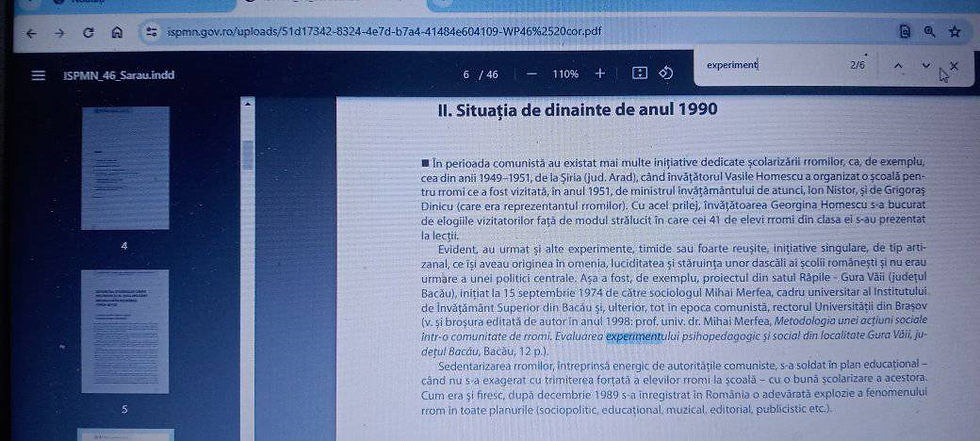


pdf ISMPN
The Rromani language from Gheorghe Sarau's chair is recognized as AN EXPERIMENT, in the book "History of the study of the Romanian language in university education in Romania", but also in the article "LINGUISTIC PLANNING FOR THE ROMANI LANGUAGE BETWEEN THE YEARS 1990 - 2011, IN ROMANIA"
"However, the analysis leads us to recommend that the linguistic-educational experiment of the Roma in Romania be taken as a model as soon as possible, to be developed and ennobled with new approaches in the field of preserving and cultivating the Romani language in all spheres of social life, both in Romania and in all other countries where Roma live"
Limba rromani de la catedra lui Gheorghe Sarau este recunoscuta ca UN EXPERIMENT, in cartea „Istoria studiului limbii romane in invatamantul universitar din Romania”, dar si in articolul „PLANIFICAREA LINGVISTICA PENTRU LIMBA ROMANI INTRE ANII 1990 - 2011. , ÎN ROMÂNIA"
„Totuși, analiza ne conduce să recomandăm ca experimentul lingvistic-educativ al romilor din România să fie luat în cel mai scurt timp drept model, să fie dezvoltat și înnobilat cu noi abordări în domeniul conservării și cultivării limbii romani în toate sfere ale vieții sociale, atât în România, cât și în toate celelalte țări în care locuiesc romii”
"On March 16, 2009, TVR3 broadcasted at the national level, in the generic show, All together, the first show on this station, in the Romanian language, with Romanian subtitles, produced by Prof. Univ. dr. Gheorghe Sarău22, which was followed by another show, this time it was a discussion conducted by Gheorghe Sarău with the young Roma Arun Durancea. Inexplicably, although Gheorghe Sarau and Ion Bîtu had recorded two other shows in the Romani language with the Roma sculptor Marian Petre and the Roma teacher from Bihor, Ionel Cordovan, TVR 3 stopped - without explanation - the transmission of these two shows, thus ending the experiment." " Conclusions In Romania, by reference to the rich and valuable arsenal of results from the linguistic-educational field, which is in symbiosis, the contribution of the other sectors with competences in the preservation and cultivation of the Romanian language was fragmented and unevenly supported, being still represented by little evidence , shy and fragile, visible artisanal, incoherent and confused, which leads us to renew the recommendation that the linguistic-educational experiment be taken over as quickly as possible as a model, developed and ennobled with new approaches in the realm of preserving and cultivating the Romanian language in all spheres of social life, equally, in Romania and in all the countries where the Roma live."
”În 16 martie 2009, TVR3 a transmis la nivel naţional, în emisiunea generică, Toţi împreună, prima emisiune, la acest post, în limba rromani, subtitrată în română, realizată de prof. univ. dr. Gheorghe Sarău22, căreia i-a mai urmat o altă emisiune, de acesta dată fiind vorba de o discuţie purtată de Gheorghe Sarău cu tânărul rrom Arun Durancea. Inexplicabil, deşi Gheorghe Sarău şi Ion Bîtu înregistraseră alte două emisiuni în limba rromani cu sculptorul rrom Marian Petre şi cu profesorul bihorean rrom, Ionel Cordovan, TVR 3 a sistat – fără explicaţii - transmiterea acestor două emisiuni, experimentul luând astfel sfârşit.” ” Concluzii În România, prin raportare la bogatul şi valorosul arsenal de rezultate din domeniul, aflat în simbioză, cel lingvistico-educaţional, contribuţia celorlalte sectoare cu competenţe în prezervarea şi cultivarea limbii rromani a fost fragmentar şi inegal susţinută, fiind încă reprezentată de dovezi puţine, timide şi fragile, vizibile artizanal, incoerente şi confuze, ceea ce ne determină să înnoim recomandarea ca experimentul lingvistico-educaţional să fie preluat cât mai grabnic ca model, dezvoltat şi înnobilat cu noi abordări pe târâmul prezervării şi cultivării limbii rromani în toate sferele vieţii sociale, deopotrivă, în România şi în toate ţările în care trăiesc rromii.”
https://litere.univ-ovidius.ro/Anale/documente-z/articole-2016-2/39%20Sarau_2_2016_art.pdf
Limba rromani de la catedra lui Gheorghe Sarău este recunoscută a fi UN EXPERIMENT, în cartea ”Istoricul studierii limbii rromani în învăţământul universitar din România”, dar și în articolul ”PLANIFICAREA LINGVISTICA PENTRU LIMBA RROMANI INTRE ANII 1990 – 2011, IN ROMANIA”
”Totuși, analiza ne conduce să recomandăm ca experimentul lingvistico-educativ al romilor din România să fie luat cât mai repede ca model, care să fie dezvoltat și înnobilat cu noi abordări în domeniul conservării și cultivării limbii romani în toate sferele, a vieții sociale, atât în România, cât și în toate celelalte țări în care locuiesc romii” https://litere.univ-ovidius.ro/Anale/documente-z/articole-2016-2/39%20Sarau_2_2016_art.pdf
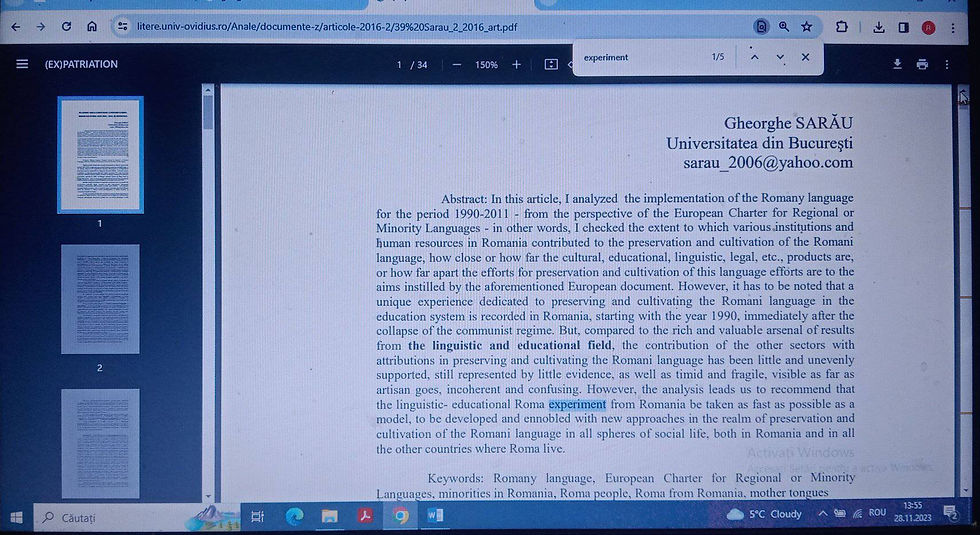


Gheorghe Sarău, in "History of the study of the Roman language in the university education in Romania (1992-2017)" (Editura Universității din Bucharest, 2017), puts in the introduction of his work, the words of Marcel Courthiade, who says:
"In September 1992, through the efforts of Mr. Gheorghe Sarău, the Rromani language entered the school curriculum in Romania - starting with the primary classes, with the success known today, where the number of students reached the level of 36,000 per year, i.e. more than a half a million children and young people, in the 25 years, went on to study the Romani language, in classes with mother tongue, Rromani literature and culture classes."
The word EXPERIMENT present in the book "History of the study of the Romanian language in university education in Romania (1992-2017)":
p. 17: "WORD FROM THE AUTHOR One of the first strategic programs of the Ministry of National Education conceived at the beginning of 1990 aimed at the creation of a young pro-active Roma ethnic intelligentsia and started in pre-university education, by establishing three experimental classes within the three Normal Schools (Pedagogical High Schools in Bucharest, Bacău, Târgu Mureş), intended to train, starting from the 1990/1991 school year, the first 55 future Roma teachers (or "teachers who will work in Roma classes") , see image 1."..." Of course, this linguistic and didactic experiment was followed by other approaches, which expanded at the faculty level, of the University of Bucharest, but also on a national scale, as we will continued to see, arriving at ways of studying the Rromani language unsuspected at the time of their initiation, unfortunately, being still little known today."
Gheorghe Sarău, în ”Istoricul studierii limbii rromani în învăţământul universitar din România (1992-2017)” (Editura Universității din București, 2017), pune în introducerea lucrării sale, cuvintele lui Marcel Courthiade, care spune:
” În Septembrie 1992, prin străduința d-lui Gheorghe Sarău, limba rromani intră în curiculumul școlar din România – pornind cu clasele primare, cu succesul cunoscut azi, unde numărul de elevi a ajuns la nivelul de 36.000 pe an, adică mai mult de o jumătate de milion de copii și tineri, în cei 25 de ani, a trecut la studiul limbii rromani, la clase cu ore de limbă maternă, de literatură şi cultură rromani.”
Cuvântul EXPERIMENT prezent în cartea ”Istoricul studierii limbii rromani în învăţământul universitar din România (1992-2017)”:
p. 17: ”CUVÂNT DIN PARTEA AUTORULUI Unul dintre primele programe strategice ale Ministerului Educaţiei Naționale gândite la începutul anului 1990 a vizat constituirea unei tinere intelectualităţi pro-activ etnic rrome și a demarat în învăţământul preuniversitar, prin înfiinţarea a trei clase experimentale în cadrul a trei Şcoli Normale (Liceele Pedagogice din Bucureşti, Bacău, Târgu Mureş), menite să-i formeze, cu începere din anul școlar 1990/ 1991, pe primii 55 de viitori învăţători rromi (sau „învăţători care vor lucra la clase de rromi”), v. imagine 1.”…” De bună seamă, acestui experiment lingvistic și didactic i-au urmat și alte abordări, ce s-au extins la nivelul facultății, al Universității din București, dar și la scară națională, așa după cum vom vedea în continuare, ajungându-se la modalități de studiere a limbii rromani nebănuite la vremea demarării lor, din păcate, fiind și azi puțin cunoscute.”
These "other approaches", on a "national scale" refer to the ENCOURAGEMENT OF MARRIAGE OF ROMA WITH RUDARS"
p.18: "Even if only by simply browsing the present work, it can be seen that we are in front of a unique experiment in the world, which completes a quarter of a century, that amazes with the coherence of the multiple approaches and initial training structures at the level university education, which had, permanently, as a link the Rromani language and literature section of Bucharest, which - through its team of teaching staff - generated and circulated similar learning structures in the national and international university and non-university space, of the invaluable benefit of which, through the prepared Romani language human resources, is visible, especially in the pre-university education units, but obviously also in other fields where the graduates and students of the Romani language study programs are active."
p. 145: "Section 2. The use of the Rromani language in public institutions - prof. dir. insp. Mihai Moldovanu, Păunița Stănescu and Mihaela Mocanu, Full study in the Romanian language for grades I - VIII. The first unique experiment from Măguri, Timiș county."
Aceste ”alte abordări”, la ”scară națională” se referă la ÎNCURAJAREA CĂSĂTORIEI ROMILOR CU RUDARII”
p.18: ” Fie și numai prin simpla răsfoire a lucrării de față, se constată că ne aflăm în fața unui experiment unic în lume, ce împlinește un sfert de veac, care uimește prin coerența multiplelor abordări și structuri de pregătire inițială de la nivelul învățământului universitar, ce au avut, în permanență, ca liant secția bucureșteană de limbă și literatură rromani, care – prin colectivul său de cadre didactice – a generat și a girat structuri similare de învățare în spațiul universitar și non-universitar național și internațional, al căror neprețuit beneficiu, prin resursele umane de limbă rromani pregătite, este vizibil, mai cu seamă, în unitățile de învățământ din preuniversitar, dar, evident, și în alte domenii în care activează absolvenții și cursanții programelor de studiere a limbii rromani.”
p. 145: ” Secțiunea 2. Utilizarea limbii rromani în instituții publice – prof. dir. insp. Mihai Moldovanu, Păunița Stănescu și Mihaela Mocanu, Studiu integral în limba rromani la clasele I – a VIII-a. Primul experiment inedit de la Măguri, jud. Timiș.”
Senator AUR Claudiu Târziu and Rudars from Bulgary who complain that they are being pressured to declare themselves Roma
Senatorul AUR Claudiu Târziu și rudarii bulgari care se plâng că se fac presiuni asupra lor să se declare romi https://www.facebook.com/251403764900829/posts/8971274422913676/?app=fbl

ROSE MARIE VOLLE: ”students are obliged to declare themselves Roma!” ”elevii sunt obligați să se declare romi!”
A French woman, Marie Volle, wrote a doctoral thesis about this unique EXPERIMENT, Rose-Marie Volle, PhD in Linguistics at DIPRALANG at the University of Montpellier, received her PhD in 2006 with the topic "Standard Romani Language in Romania". He is currently a lecturer in linguistics at the University of Franche-Comté Here is the summary of this thesis:
The author rejects the false classification of dialects into four categories, proposed by Gheorghe Sărău, and claims that the reality is much more complex. She claims that although the Roma involved in NGOism claim to understand any Roma in Europe, she states from experience that the Roma from the village of Zece Prăjini say they cannot understand the Roma from Kalderash. Another important observation of the author is that there are practically no native speakers at the Romani Faculty. So, says Rose-Marie Volle, a teacher who doesn't know Romani/Gypsy is teaching a canonized language -- canonized by a non-Roma Romanian, I should add. She continues with another justified observation that there are no history, mathematics or civics textbooks... Nor does the author omit the ironic name that was given to the language invented by Sarau, "Sarau-ian" (the language of the peasantry), claiming that by this name, this invented language, the Sarauan dialect, has neither legitimacy nor power.
În legătură cu acest EXPERIMENT inedit, o franțuzoaică, Marie Volle, a scris o teză de doctorat. Rose-Marie Volle, doctor în lingvistică la DIPRALANG la Universitatea din Montpellier, și-a luat doctoratul în 2006 cu tema „Limba romani standard în România”. În prezent, este lector în științe lingvistice la Universitatea Franche-Comté
Iată rezumatul acestei teze:
Autoarea respinge falsa clasificare a dialectelor în patru categorii, propusă de Gheorghe Sărău, şi susţine că realitatea este mult mai complexă. Ea susține că, deși rromii implicați în ONGism susțin că înțeleg orice rom din Europa, ea afirmă din experiență că romii din satul Zece Prăjini spun că nu-i pot înțelege pe romii din Kalderash. O altă observație importantă a autorului este că la Facultatea de Romani nu există practic vorbitori nativi. Așadar, spune Rose-Marie Volle, o profesoară care nu știe romani predă o limbă canonizată -- canonizată de un român, ar trebui să adaug. Ea continuă cu o altă observație justificată că nu există manuale de istorie, de matematică sau de educație civică... Nici autoarea nu omite denumirea ironică care a fost dată limbajului inventat de Sarau, „Sarau-ian” (limba sărăului), susținând că prin acest nume, această limbă inventată, dialectul Sarauan, nu are nici legitimitate, nici putere.
The author also shows that the information from the History and Traditions Manual of the Roma Minority, written by Delia Grigore, D. Petcut and M. Sandu, is not found in the collective memory of the Roma. The Roma do not know of any exodus of their ancestors from India through Africa or Egypt, as claimed in the book. About the chapter "Rromanipen", the author draws attention to the fact that although the textbook describes certain Romani traditions - ritual purity, marriage - it is still dangerous because students will not be able to recognize them because Romani traditions are varied. Just like the Roma language, I would say. The final conclusion of Mlle. Rose-Marie Volle is that in Romania it is disturbing to study the standardized Romani language at the expense of traditional dialects. Although she also believes that the teaching of the Romani language in schools could lead to the official recognition of all dialects. The end of the text reveals the pessimism of the fieldwork: the Romani language could be a valuable tool if its teaching were not based on the obligation of students to recognize themselves as Roma. The words of the linguist Rose-Marie Volle are the most appropriate, not our commentary: "This entails the establishment of a multilingual education that looks at language use as a set of options within a language curriculum as a continuum. But for the moment, the teaching of the Romanian language borrows its methods from its only model, the teaching of a national language, which, based on the notion of error, on a standard, ensures the recognition of this language by those who are supposed to adopt it. "
De asemenea, autorea mai arată că informaţiile din Manualul de istorie şi tradiţii ale minorităţii romilor, scris de Delia Grigore, D. Petcuţ şi M. Sandu, nu se regăsesc în memoria colectivă a romilor. Romii nu știu despre nici un exod al strămoșilor lor din India prin Africa sau Egipt, așa cum se susține în carte. Despre capitolul „Rromanipen”, autorul atrage atenția asupra faptului că, deși manualul descrie anumite tradiții rome – puritatea rituală, căsătoria – este totuși periculos, deoarece studenții nu le vor putea recunoaște deoarece tradițiile rome sunt variate. La fel ca limba romilor, aș spune.
Concluzia finală a lui Mlle. Rose-Marie Volle este că în România este deranjant să studiezi limba romani standardizată în detrimentul dialectelor tradiționale. Deși ea mai crede că predarea limbii romani în școli ar putea duce la recunoașterea oficială a tuturor dialectelor. Sfârșitul textului relevă pesimismul muncii de teren: limba romani ar putea fi un instrument valoros dacă predarea ei nu s-ar baza pe obligația elevilor de a se recunoaște ca romi. Cuvintele lingvistului Rose-Marie Volle sunt cele mai potrivite, nu comentariul nostru:
„Acest lucru presupune instituirea unei educații multilingve care să privească utilizarea limbii ca un set de opțiuni în cadrul unui curriculum lingvistic sub forma unui continuum. Însă, pentru moment, predarea limbii romani își împrumută metodele din singurul său model, predarea unei limbi naționale, care bazându-se pe noțiunea de greșeală, pe un standard, asigură recunoașterea acestei limbi de către cei care se presupune că o adoptă. ”
Daniel Caraivan, in his book, "Mixed marriages and their effects on the ethnic identity of the Roma", prefaced by Professor Delia Grigore, Etnous Publishing House, ISBN 978-606-712-612-9, 2019, p. 7, tried to DENY DETHNICIZATION OF THE ROMA THROUGH MIXED MARRIAGE WITH RUDARS, the experiment done at the Rromani department:
Daniel Caraivan, în cartea sa, ”Căsătoriile mixte şi efectele acestora asupra identității etnice a romilor”, prefațată de profesoara Delia Grigore, Editura Etnous, ISBN 978-606-712-612-9 , 2019, p. 7, a încercat să NEGE DEZETNICIZAREA ROMILOR PRIN CĂSĂTORII MIXTE cu rudarii, experimentul făcut la catedra de rromani:


"The investigated target group The target group that is the subject of the paper is made up of the active Roma and non-Roma ethnic population from the territory of Romania, divided as follows: - legally married or cohabiting couples, made up of Roma/Romania and non-Roma; - legally married or cohabiting couples, made up of non-Roma; - legally married or cohabiting couples made up of Roma; - formal representatives of the Roma (local experts, health/school mediators); - Roma activists. In order to have a clearer perspective, we conducted interviews in several counties in the country (Argeș, Brăila, Bucharest, Buzău, Constanța, Ialomița, Prahova, Sălaj and Botoşani). I conducted semi-structured interviews with representatives of a non-governmental organization, which carries out inclusion activities for the Roma ethnic group."
”Grupul-țintă investigat
Grupul-țintă care face obiectul lucrării este constituit din populație activă de etnie romă și neromă de pe teritoriul României, împărțită astfel: - cupluri căsătorite legal sau care conviețuiesc în concubinaj, formate din rom/romnie și nerom/ă; - cupluri căsătorite legal sau care conviețuiesc în concubinaj, formate din neromi; - cupluri căsătorite legal sau care conviețuiesc în concubinaj, formate din romi; - reprezentanți formali ai romilor (experți locali, mediatori sanitari/școlari); - activiști romi. Pentru a avea o perspectivă mai clară, am realizat interviuri în mai multe județe din țară (Argeș, Brăila, București, Buzău, Constanța, Ialomița, Prahova, Sălaj și Botoșani). Am realizat interviuri semistructurate cu reprezentanți ai unei organizații nonguvernamentale, ce desfășoară activități de incluziune pentru etnia romă.”
He who excuses himself, accuses himself
Daniel Caraivan, coordinated by Delia Grigore, conducted interviews on mixed couples, Rudars+Roma, with the help of an unspecified NON-GOVERNMENTAL ORGANIZATION (STATE SECRET, obviously). My wife is a SCHOOL MEDIATOR in Prahova, it is easy to understand that I was also investigated, secretly, since the name of that NGO is secret.
From the title of the paper we clearly read the intention of the NGO that researched mixed marriages between Rudars and Roma: the effects. Twice the author DENIES that there is a plan, a strategy, to mix the Roma with the Rudari, but passes them off as Roma. Then, the introduction of the book coordinated by Delia Griogore is clear, especially since the question presupposes an ACCUMULATION, and Caraivan's book is the exoneration, the denial of the experiment REROMIZATION OF MINING:
"Is the assimilation of the Roma ethnicity desired by the majority? As can be seen, in the inter-ethnic relations between Romanians and Roma, due to the attractive force of the Romanian identity, there are mutations in the ethnic identity of the Roma that consist in the absorption by the Roma of the fundamental features specific to the Romanian ethnicity, such as the language, the way of life, occupations, customs, followed by the declaration of their ethnicity as Romanians in the population census. The transition from the univocal identity (which has only one meaning or keeps the same meaning in different uses, n.n.) of Roma/Gypsy to the identity of Romanian signifies the shaking of the primary ethnicity and the beginning of biculturalism."
Cine se scuză, se acuză
Daniel Caraivan, coordonat de Delia Grigore, a efectuat interviuri pe cupluri mixte, rudari+romi, cu ajutorul unei ORGANIZAȚII NONGUVERNAMENTALE nespecificate (SECRET DE STAT, evident). Soția mea, este MEDIATOR ȘCOLAR în Prahova, lesne de înțeles că și eu am fost investigat, în secret, din moment ce numele acelui ONG este secret.
Din titlul lucrării citim clar intenția ongului care a cercetat căsătoriile mixte între rudari și romi: efectele. De două ori autorul NEAGĂ că ar exista un plan, o strategie, de a amesteca romii cu rudarii, dar îi trece în rândul romilor. Apoi, introducerea cărții coordonate de Delia Griogore este clară, mai ales că întrebarea presupune o ÎNVINOVĂȚIRE, iar cartea lui Caraivan este dezvinovățirea, negarea experimentului REROMIZAREA RUDARILOR:
”Se doreşte asimilarea etniei romilor de către majoritari? După cum se observă, în relaţiile interetnice dintre români şi romi, datorită forţei de atracţie a identităţii românilor, în identitatea etnică a romilor au loc mutaţii ce constau în absorbţia de către romi a trăsăturilor fundamentale specifice etniei române, precum limba, modul de viaţă, ocupaţiile, obiceiurile, urmate de declararea etniei lor ca români la recensământul populaţiei. Trecerea de la identitatea univocă (care are un singur sens sau păstrează același sens în întrebuințări diferite, n.n.) de rom/ţigan la identitatea de român semnifică zdruncinarea etniei primare şi începutul biculturalităţii.”

Mr. Caraivan uses the adjective "univocal" to conceal the fact that in ROMI, the ethnicity is defined by marriage with an ethnic ROMA, only then, the sheavoro/sheiori ethnicity/ethnicity become ROMA and ROMANI. His book copiously copies the denial of the traditional Roma law through knowledge of the Romani language, copiously reproducing entire passages from "From victimization to citizenship conscience", that "the Romani language does NOT belong to the Roma" (p. 83). As such, Mr. Caraivan's book is RACIST, ANTI-Roma, and must be BANNED, like EVERYTHING the Romani language department has published so far, based on the anti-Gypsy law.
On page 41, Daniel Caraivan, coordinated by Delia Grigore, includes Rudars among the categories of Roma:
"The maelstrom of social and economic transformations caused some of the Roma clans to dissipate, at this moment a number of approximately 15 are mentioned, as follows: boldens, bricklayers, blacksmiths, spoitors, usars, boilermakers, silversmiths, rudars, corbens, fiddlers, horahanes (Turkish Roma), lovars, vátrasi, gabori, Hungarian Roma (Hungarian Roma), defined by the spoken dialect as belonging to a nation and by the profession that is practiced within that nation."
Domnul Caraivan folosește adjectivul ”univoc” pentru a oculta faptul că la ROMI, etnia este definitivată prin căsătorie cu un etnic ROM, de abia atunci, etnicul/etnica sheavoro/sheiori devin ROM și ROMNI. Cartea sa copiază din belșug negarea legii tradiționale rome prin cunoașterea limbii romani, reproducând copios pasaje întregi din ”De la victimizare la conșțiința cetățenească”, că ”limba romani NU este a romilor” (p. 83). Ca atare, cartea domnului Caraivan este RASISTĂ, ANTI-ROMĂ, și trebuie INTERZISĂ, ca și TOT ceea ce catedra de limba rromani a publicat pînă acum, pe temeiul legii anti-țigănismului.
La pagina 41, Daniel Caraivan, coordonat de Delia Grigore, include rudarii între categoriile de romi:
”Vâltoarea transformărilor sociale și economice a făcut ca o parte din neamurile de romi să se disipeze, în acest moment fiind menţionate un număr de aproximativ 15, astfel: boldeni, cărămidari, fierari, spoitori, ursari, căldărari, argintari, rudari, corbeni, lăutari, horahane (romi turci), lovari, vătraşi, gabori, romi ungre (romi unguri), definite prin dialectul vorbit ca aparţinând unui neam şi de meseria care este practicată în interiorul acelui neam.”

Daniel Caraivan, coordinated by Delia Grigore, on pages 124-125, writes:
"We cannot discuss a method of voluntary integration through mixed marriages, the loss of identity happens involuntarily, there is no strategy or personal plan in which something specific happens through this type of marriage. Everything starts from a love relationship, if one of the young people has a thinking based on prejudices and stereotypes, that marriage does not take place. Ethnic identity undergoes changes in intermarriage due to several factors, namely: • The involvement of the parental family, which does not agree with the marriage. • Dominance in marriage, whoever dominates more will impose their identity. • Children – the fear of not going through what the Roma father or mother went through (school segregation, ethnic ironies, low self-esteem). • Promotion in the mass media of news with a negative connotation of the Roma ethnic group."
Daniel Caraivan, coordonat de Delia Grigore, la paginile 124-125, scrie:
”Nu putem discuta de o metodă de integrare voită prin căsătoriile mixte, pierderea identității se întâmplă involuntar, nu există o strategie sau vreun plan personal în care prin acest tip de căsătorie să se întâmple ceva anume. Totul pornește de la o relație de dragoste, dacă unul din tineri are o gândire bazată pe prejudecăți și stereotipuri, acea căsătorie nu are loc. Identitatea etnică suferă modificări în căsătoria mixtă datorită mai multor factori, și anume: Implicarea familiei parentale, care nu este de acord cu căsătoria. Dominarea în căsătorie, cine domină mai mult acela își va impune identitatea. Copiii – teama de a nu trece și ei prin ceea ce a trecut tatăl sau mama de etnie romă (segregare școlară, ironii cu temă etnică, stimă de sine scăzută). Promovarea în mass-media a știrilor cu tentă negativă a etniei rome.”
In reality, the Rudars hate the Roma language, and will not let their grandchildren learn the language from their native speaking parent.
Daniel Caraivan, coordinated by Delia Grigore, on pages 128-129, writes:
"A second important conclusion is related to mixed marriages and their effects on the Roma ethnic identity, this type of marriage being frequently encountered. We cannot speak of a strategy in this case, because, of course, it is an involuntary and uncontrollable phenomenon. In this type of marriage we encounter different attitudes from case to case. One thing is clear, if two young people of different ethnicities (Roma and non-Roma) love each other and decide to take this important step in their lives, they do not have prejudices and stereotypes towards each other, or at least they have eliminated them. Naturally, this type of marriage should be an advantage due to the cultural/traditional mix, in reality one of the two will give in from an ethnic identity point of view and obviously the Roma partner who comes with a negative ethnic baggage gives in . In general, the racist pressure in mixed marriages is put by the parental families, the parents continuously feed with ideas based on prejudices and stereotypes, especially this kind of pressure happens from the non-Roma family, who accept this type of marriage the hardest. The Roma ethnic identity is affected by mixed marriages, in most cases the Roma ethnic partner gives in and no longer recognizes his belonging to the Roma ethnicity, considering that he can get rid of the negative image attributed by the majority to the Roma ethnicity. There is also a category of mixed marriages where biculturalism occurs."
In conclusion, Daniel Caraivan's book, coordinated by Delia Grigore, aims to exonerate the false Romani language department of the University of Bucharest, and the CNCR Romano-Kher, that they would try to assimilate the Roma, but the proof that this is so is the inclusion of the Rudaris in the list of Roma nations, on page 41.
În realitate, rudarii urăsc limba romilor, și nu îi vor lăsa pe nepoți să învețe limba de la părintele vorbitor nativ.
Daniel Caraivan, coordonat de Delia Grigore, la paginile 128-129, scrie:
”O a doua concluzie importantă este legată de căsătoriile mixte și efectele acestora asupra identității etnice rome, acest tip de mariaj fiind frecvent întâlnit. Nu putem vorbi de o strategie în acest caz, deoarece, firesc, este un fenomen involuntar și necontrolabil. În acest tip de mariaj întâlnim atitudini diferite de la caz la caz. Este clar un singur lucru, dacă doi tineri de etnii diferite (romă și neromă) se iubesc și hotărăsc să își asume acest pas important în viața lor, nu au prejudecăți și stereotipuri unul față de celălalt sau, cel puțin, le-au eliminat. În mod firesc, acest tip de căsătorie ar trebui să constituie un avantaj datorită mixtului cultural/tradițional, în realitate unul dintre cei doi va ceda din punct de vedere etnic identitar și în mod evident cedează partenerul de etnie romă care vine cu un bagaj etnic negativ. În general, presiunea rasistă în căsătoriile mixte este pusă de familiile parentale, părinții alimentează continuu cu idei bazate pe prejudecăți și stereotipuri, în special acest tip de presiune se întâmplă din partea familiei nerome, care acceptă cel mai greu acest tip de mariaj. Identitatea etnică romă este afectată de căsătoriile mixte, în mare parte a cazurilor partenerul de etnie romă cedează și nu își mai recunoaște apartenenţa la etnia romă, considerând că poate scăpa de imaginea negativă atribuită de majoritari etniei rome. Există și o categorie de căsătorii mixte în care apare biculturalitatea.”
În concluzie, cartea lui Daniel Caraivan, coordonată de Delia Grigore, are ca scop dezvinovățirea catedrei de falsa limbă rromani a Universității București, și a CNCR Romano-Kher, că ar încerca să facă asimilarea romilor, dar dovada că este așa, este includerea rudarilor în lista de neamuri rome, la pagina 41.
Evidence of the Roma assimilation conspiracy through the deception that the Rudari are Roma.
"R. B: - Romani language teacher and school mediator in Prahova county..."I come from a family of non-speaking "gypsies", Rudars I think, on the father's and mother's side. For me, as a non-speaker, what I learned during college was the basis, but during the years that followed, I can say that I really got to know the Romani language, with its particularities and "subtleties", due to the fact that - hearing and speaking this language daily - I managed to acquire it and think in it. And this thanks to my husband, a native speaker, whom I also met at the Romanian language section (here I must remember Delia's role as "bear", who, after seeing us contradicting as "URSITOARE" (”a ursi” – ”to decide the future of someone”, my observation, CMN), who, after seeing us contradicting each other, said: "These two surely will marry each other!".
!")" Source: Gheorghe Sarău, "History of the study of Romanian language in university education in Romania (1992-2017)"
Dovada conspirației de asimilare a romilor prin înșelăciunea că rudarii sunt romi.
”R. B: - profesoară de limba rromani și mediator școlar în județul Prahova…“Provin dintr-o familie de “țigani” nevorbitori, rudari cred, din partea tatălui și a mamei. Pentru mine, ca nevorbitoare, ceea ce am învățat în timpul facultății a constituit baza, însă pe parcursul anilor ce au urmat, pot spune că am ajuns să cunosc limba rromani cu adevărat, cu particularitățile și "finețurile" ei, datorită faptului că - auzind și vorbind zilnic această limbă - am reușit să mi-o însușesc și să gândesc în ea. Și asta mulțumită soțului meu, vorbitor nativ, pe care l-am întâlnit tot la secția de limbă romani (aici trebuie să amintesc rolul Deliei de "ursitoare", care, după ce ne-a văzut contrazicându-ne, a spus: "Ăștia doi sigur se iau!") ” Sursa: Gheorghe Sarău, ”Istoricul studierii limbii rromani în învăţământul universitar din România (1992-2017)” An aparitie: 2017 Numar de pagini: 442 Format: B5 ISBN: 978-606-16-0929-1, Editura Universității din București.https://editura-unibuc.ro/istoricul-studierii-limbii-rromani-in-invatamantul-universitar-din-romania-1992-2017/My name, CÎRPACI MARIAN NUȚU, is written in this book, as a former student, on pages 112, 318, in pdf.Numele meu, CÎRPACI MARIAN NUȚU, este scris în cartea aceasta, ca fost student, la paginile 112, 318, în pdf.
URSITOÁRE,ursitoare,s. f. (În superstiții) 1. Ființă imaginară despre care se crede că are darul de a hotărî soarta omului de la naștere. 2. (Înv.) Soartă, destin, ursită. [Pl. și: ursitori] – Din ursi + suf.-(i)toare.
URSITOÁRE, ursitoare, s. f. (In superstitions) 1. Imaginary being who is believed to have the gift of deciding the fate of man from birth. 2. (Inv.) Fate, destiny, destiny. [Pl. and: bears] – From bears + suffix -(i)toare.URSÍ,ursesc,vb. IV. Tranz. (În credințele și basmele populare) A hotărî dinainte soarta unei ființe sau a unui lucru; a meni, a predestina. ♦ A face cuiva farmece, vrăji. – Din ngr.oríso (viit. lui orízo).
URSÍ, ursesc, vb. IV. Trans. (In folk beliefs and fairy tales) To predetermine the fate of a being or thing; to meni, to predestinate. ♦ Casting charms, spells on someone. – From Engr. oríso (viit. of orízo).


Courthiade: "CONFUSE THE RUDARIANS WITH THE ROMA AND CONQUER!"/”CONFUNDĂ RUDARII CU ROMII ȘI CUCEREȘTE!”
We read in Cécile Canut's article, The Romani Language: A Historical Fiction (Université Paris René Descartes), that Marcel Courthiade classifies the Rudars and Boaysh (Beas/Băiaș) as "false Roma", whom he, Courthiade, also "hunts" , not to mix with the Roma, who are of noble Indian origin, and not to be amalgamated with other races. It is clear that Courthiade is the supreme manipulator, since he re-coined the Latin saying "divide et impera" into "confunde et impera" (in the book "Roma or Gypsy...", the article written by Courthiade, "Rromani - a language poor and empty?”):
Citim în articolul lui Cécile Canut, The Romani Language: A Historical Fiction (Université Paris René Descartes), că Marcel Courthiade îi clasifică pe rudari/băiași (Beas) ca ”falși romi”, pe care tot el, Courthiade, îi ”vânează”, pentru a nu se amesteca cu romii, care au origine nobilă indiană, și nu trebuie amalgamați cu alte rase. Este clar că Courthiade este supremul manipualtor, din moment ce el a recoinizat dictonul latin ”divide et impera”, în ”confunde et impera” (în cartea ”Rom sau Țigan...”, articolul scris de Courthiade, ”Rromani - o limbă săracă și goală?”):
”In the name of the origin, the creation of a closed inventory of minorities is divested of all social and political considerations. Hence, the Béas, Ashkali, Travelers, Yniches, Balkan Egyptians, Evgjits, etc., are carefully set aside (Courthiade 2002, 2003) as “false Roma” despite the attribution of the ethnonym “Tzigane” or the Romani terms that some use. To each his origin.” ...” Why such a need for identity closure? Quite simply because the political and economic stakes are determinant. This hunt for false Roma results in a multitude of new labels (Acton 1989, 89), new minorities, which, in turn, claim the right to establish their nation. These discourses of categorization lead to hierarchizations in order to avoid any stigmatizing amalgamations. The “true” Roma cannot be assimilated with all the excluded populations of the earth; their noble Indian origin makes it possible to distinguish them from others.”
” În numele originii, crearea unui inventar închis al minorităților este lipsită de orice considerații sociale și politice. Prin urmare, Béas, Ashkali, Travelers, Yniches, Balcanian Egyptians, Evgjits etc., sunt puși deoparte (Courthiade 2002, 2003) ca „falși romi” în ciuda atribuirii etnonimului „Tzigane” sau a termenilor romi pe care unii îi folosesc. Fiecare cu originea lui.” ...” De ce o asemenea nevoie de închidere a identităţii? Pur și simplu pentru că mizele politice și economice sunt determinante. Această vânătoare de falși romi are ca rezultat o multitudine de noi etichete (Acton 1989, 89), noi minorități, care, la rândul lor, își revendică dreptul de a-și întemeia națiunea. Aceste discursuri de categorizare duc la ierarhizări pentru a evita orice amalgamări stigmatizante. Romii „adevărați” nu pot fi asimilați cu toate populațiile excluse ale pământului; originea lor nobilă indiană face posibilă deosebirea lor de ceilalți.”
Sursa: https://www.cairn-int.info/article-E_LS_136_0055--the-romani-language-a-historical-fiction.htm
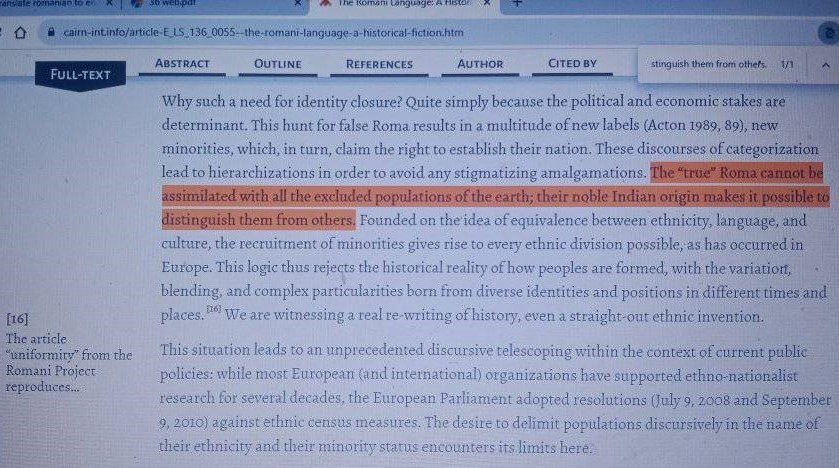

THE PURPOSE OF HUNTING FAKE ROMA IS EXACTLY TO MIX THEM THROUGH CONFUSION WITH REAL ROMA WHO DID NOT KNOW THAT THE RUDARIANS WERE OF EGYPTIAN OR MOESO-ROMANIAN ORIGIN. If Marcel Courthiade in two articles cited by Cecile Canout (Vous avez-dit Ashkali? J'avais compris Égyptien », Bulletin de l'INALCO, p. 71-88, 2002; « Les Rroms dans le contexte des peuples européens sans territoire compact », Rapport redacted dans le cadre du séminaire « Rroms et groupe analogues », Strasbourg 31 Sept.-1st Oct 2003. We find the names of these articles in the bibliography of the article written by Cecile Canout) states that the Roma should not be assimilated with other races confused with the Roma, and in the article, written in the book "Roma or Gypsy, the dilemmas of an ethnonym", edited by the Government of Romania, and the SOROS FOUNDATION, he writes that although the Rudars and Boaysh are not Roma, because their ancestors never spoke the Romani language, he declares , Marcel Courthiade, "rebaptize the Roma for a politically correct instance", and uses the principle "CONFUNDE ET IMPERA", invented by himself, means that the NGO IRU and the Romanian Language Department of the University of Bucharest are in a declared war against genetics the Roma.
Scopul VÂNĂTORII DE FALȘI ROMI ESTE TOCMAI AMESTECUL LOR PRIN CONFUZIE CU ROMII CARE NU ȘTIAU CĂ RUDARII SUNT DE ORIGINE EGIPTEANĂ, sau MOESO-ROMÂNĂ. Dacă Marcel Courthiade în două articole citate de Cecile Canout (Vous avez-dit Ashkali? J’avais compris Égyptien », Bulletin de l’INALCO, p. 71-88, 2002; « Les Rroms dans le contexte des peuples européens sans territoire compact », Rapport rédigé dans le cadre du séminaire « Rroms et groupe analogues », Strasbourg 31 sept.-1e oct 2003. Găsim numele acestor articole în bibliografia articolului scris de Cecile Canout) afirma că romii nu trebuie asimilați cu alte rase confundate cu romii, iar în articol, scris în cartea ”Rom sau Țigan, dilemele unui etnonim”, editată de Guvernul României, și SOROS FOUNDATION, scrie că deși rudarii/băieșii nu sunt romi, pentru că niciodată strămoșii lor nu au vorbit limba rromani, îi declară el, Marcel Courthiade, ”rebotezați rromi pentru o instanță politic corectă”, și folosește principiul ”CONFUNDE ET IMPERA”, inventat de el însuși, înseamnă că ong-ul IRU și Catedra de limba rromani a Universității București sunt într-un război declarat contra geneticii romilor.
SOROS MISLED by Enikő VINCZE?
Dear readers, please read carefully the contradictions written on one page: the Rudarii do not speak the Romani language, and they do not declare themselves Roma, but...the OPERE team of writers (this is what it says on the first page: "The Institute of Cultural Anthropology from Cluj, aims to publish some original works") declares that the RUDARII are Roma. p.162: "The Rudarii do not speak the Romani language and do NOT declare themselves Roma. Compared to the spoitors from the vicinity of the Danube, the social cohesion within the rudar group is much weaker. In the case of Rudars, migration to France, Italy, Spain is widespread. Entire families usually migrate, so you can see recently built houses empty. They too practice usury lending, like the moneylenders. Negoi commune In Negoi commune, in the neighborhood called "the new village" we met two Roma communities: one of Rudars and one of Bricklayers." p.174: But what does school represent for traditional Roma? We use the visits to the communities in our cluster to answer this question, communities made up of Roma spoitors, Rudaris and bricklayers, so traditional. p.176: "Another aspect that we want to note in the conclusions chapter refers to the relationship, the interaction between the different cultural subgroups of Roma (spoitors, rudars, bricklayers) on the one hand, and on the other hand, to the relations between members of the same cultural subgroup. Regarding the relations between members belonging to different cultural subgroups, I noticed that there are marriages between Spoitors (tinners) and Rudars, but only between poor members of the groups"p. 184:” În comuna Mironeasa sunt două segmente de romi care se află în conflict. Prima comunitate este cea a ursarilor care trăiește într-o comunitate compactă într-o zonă numită Brustureț. Cealaltă este comunitatea lingurarilor sau rudarilor.”
Case studies in the counties of Alba, Arad, Călărași, Dolj and Iași Authors: #Cătălin Dîrțu, # Adrian-Nicolae Furtună, #Margareta Herțanu, #Iulia-Elena Hossu, #Andrei Tudor MihaiL, #Elena Mihalache, #Rafaela Maria Muraru, #Florina Pop, #Mihaela Preda, #Elena Trifan, #Daniel TUDORA, #Enikő Vincze, Publisher Foundation for European Studies Cluj, 2014, This volume resulted from the second phase of the research Faces and Causes of Marginalization of the Roma in Local Settings. Contextual inquiry to the UNDP/World Bank/EC Regional Roma Survey 2011, focusing on Hungary, Romania, Serbia. A joint initiative of the United Nations Development Programme (UNDP), the Open Society Foundation's Roma Initiatives Office (RIO) and the Making the Most of EU Funds for Roma Inclusion program, and the Central European University/Center for Policy Studies (CEU CPS.) The initiative was funded by the United Nations Development Programs and Open Society Foundations. Managed by EFES and the Institute of Cultural Anthropology in Cluj, it aims to publish original works, translations, didactic materials, workshop works and conferences in the field of cultural anthropology, European ethnology, gender studies and cultural studies . As such, it wishes to contribute to the institutionalization of these disciplines in Romania and to the presentation of the results of cultural and social research carried out in post-socialist Eastern Europe.

SOROS INDUS în EROARE de Enikő VINCZE?
Dragi cititori, vă rog să citiți cu atenție, contradicțiile scrise pe o singură pagină: rudarii nu vorbesc limba rromani, și nu se declară romi, dar...echipa de scriitori de OPERE (așa scrie pe prima pagină: ”Institutul de Antropologie Culturală din Cluj, îşi propune publicarea unor opere originale”) declară că RUDARII sunt romi.
p.162: ”Rudarii nu vorbesc limba romani și NU se declară romi. În comparație cu spoitorii din vecinătatea Dunării, coeziunea socială în cadrul grupului rudarilor este mult mai slabă. În cazul rudarilor, migrația în Franța, Italia, Spania este răspândită. De obicei migrează familii întregi, de aceea se pot vedea casele recent construite goale. Și ei practică împrumutul cu camătă, ca și spoitorii. Comuna Negoi În comuna Negoi, în vecinătatea numită „satul nou” am întâlnit două comunități de ROMI: una de rudari și una de cărămizari.”p.174: ”Însă ce reprezintă școala pentru romii tradiționali? Ne folosim de vizitele în comunitățile din clusterul nostru pentru a răspunde la această întrebare, comunități formate din romi spoitori, rudari și cărămizari, deci tradiționale. p.176: ”Un alt aspect pe care dorim să îl notăm în capitolul concluziilor se referă la relația, interacțiunea dintre diferitele subgrupuri culturale de romi (spoitori, rudari, cărămizari) pe de o parte, iar pe de altă parte, la relațiile dintre membrii aceluiași subgrup cultural. Referitor la relațiile dintre membrii aparținând unor subgrupuri culturale diferite, am observat că au loc căsătorii între spoitori (cositorari) și rudari, însă doar între membrii săraci ai grupurilor”p. 184: "In Mironeasa commune there are two segments of Roma who are in conflict. The first community is that of Bears/Ursari living in a compact community in an area called Brustureț. The other is the community of Spooners or Rudars.”
Studii de caz în județele Alba, Arad, Călărași, Dolj și Iași Autori: #Cătălin Dîrțu, #Adrian-Nicolae Furtună, #Margareta Herțanu, #Iulia-Elena Hossu, #Andrei Tudor MihaiL, #Elena Mihalache, #Rafaela Maria Muraru, #Florina Pop, #Mihaela Preda, #Elena Trifan, #Daniel TUDORA, #Enikő Vincze, Editura Fundaţiei pentru Studii Europene
Cluj, 2014, Acest volum a rezultat din faza a doua a cercetării Faces and Causes of Marginalization of the Roma in Local Settings. Contextual inquiry to the UNDP/World Bank/EC Regional Roma Survey 2011, focusing on Hungary, Romania, Serbia. A joint initiative of the United Nations Development Programme (UNDP), the Open Society Foundation’s Roma Initiatives Office (RIO) and the Making the Most of EU Funds for Roma Inclusion program, and the Central European University/Center for Policy Studies (CEU CPS.) Inițiativa a fost finanțată de United Nations Development Programme și de Open Society Foundations.Îngrijită de EFES şi de Institutul de Antropologie Culturală din Cluj, îşi propune publicarea unor opere originale, traduceri, materiale didactice, lucrări de atelier şi conferinţe din domeniul antropologiei culturale, etnologiei Europene, studiilor de gen şi studiilor culturale. Ca atare doreşte să contribuie la instituţionalizarea acestor discipline în România şi la prezentarea rezultatelor cercetărilor culturale şi sociale desfăşurate în Europa de Est post-socialistă.
I wonder if the Rudars non-Roma married to the Spoitors Roma are not somehow introduced in this assimilation experiment? Possible. What is clear from this book by Eniko Vincze, is the fact that the SISROM system notes that there are also conflicts between the Ursari Roma and Rudari (non-Roma) .
Eu mă întreb dacă nu cumva rudarii căsătoriți cu spoitorii, nu sunt cumva introduși în acest experiment de asimilare? Posibil. Ceea ce e clar din cartea aceasta a lui Eniko Vincze, este faptul că sistemul SISROM notează că există și conflicte între romii ursari și rudari.
Another very important detail for our approach in the history of this modern ethno-genesis of the Rudar people called "Rrom" politically correct, but historically incorrect, was the idea of the re-Romanization of the Rudars, by "acquiring ethnicity through the Romanian language taught by Gheorghe Sarău . ”, a phenomenon that is mentioned in an article (Bogdan Neagotă, Ileana Benga, The Healing Gurban On the Traces of the Rudari from Southern Romania, in Transylvanian Review, Vol XXV, No. 1 (Spring 2016), p. 76) : ”On the other hand, certain researchers, activists of the Rroma national construction, such as Gheorghe Sarãu or Delia Grigore, claim the necessity of “re-Rromizing” the Rudari, by means of teaching them the Rromani language.” (folder Sarau Delia reromizare rudari)
Un alt amănunt foarte important pentru demersul nostru în istoria acestei etno-geneze moderne a poporului rudăresc denumit ”rrom” dpdv politic corect , dar incorect dpdv istoric, a fost ideea re-romizării rudarilor, prin ”dobândirea etniei prin limba romani predată de Gheorghe Sarău”, fenomen despre care aflăm dintr-un articol (Bogdan Neagotă, Ileana Benga, The Healing Gurban On the Traces of the Rudari from Southern Romania, în Transylvanian Rewiew, Vol XXV, No. 1 (Spring 2016), p. 76):
„câţiva cercetători, activişti ai construcţiei naţionale rrome, ca Gheorghe Sarău şi Delia Grigore, afirmă necesitatea re-rromizării rudarilor, prin învăţarea limbii rromani.” În notiţa explicativă nr 15, de la pagina 90 autorii articolului explică: „în judeţul Argeş, în anumite comunităţi de rudari, un curs de limba rromani a fost introdus oficial, fără rezultate concrete.”

However, no one in the world can become a genetic part of an ethnic group, by graduating from a faculty where the language of that ethnic group is taught. Here is the proof from the "Romai everywhere" Facebook group, that Gheorghe Sarau supports the re-Romanization of the non-Roma "Gypsies", by re-learning the Romani language, although Gheorghe Sarau knew from his hierarchical superior, Marcel Courthiade, that the Rudars and Boyash they weren't Roma, because they don't know the Rromani language, and DON'T LOVE IT EVEN:
Or, nimeni în lume nu poate deveni parte genetică a unei etnii, prin absolvirea unei facultăți unde se predă limba acelei etnii. Iată dovada de pe grupul Facebook ”Romii de pretutindeni”, că Gheorghe Sarău susține re-romizarea ”țiganilor” ne-romi, prin re-învățarea limbii romani, deși Gheorghe Sarău știa de la superiorul său ierarhic, Marcel Courthiade, că rudarii și băieșii nu au fost romi, pentru că nu știu limba romani, și NICI NU O IUBESC.
Gheorghe Sarău, in a discussion on Facebook, the group "Romii de pretutindeni", says "Identity reconstruction must be done, first of all through its binder, the language."
Gheorghe Sarău, într-o discuție pe Facebook, grupul ”Romii de pretutindeni”, spune ”Trebuie făcută reconstrucție identitară, în primul rând prin liantul ei, limba.”
Proof that teaching children of Romanians with chocolate skin, possibly Rudari, it is an OFFICIAL EXPERIMENT. The Rudars and black Romanians are believed to be "Gypsies" by white Romanians, are misled that they are Roma, and learn the Romani Indian language at the school in Boldești commune, Prahova county. The reporter clearly says that "this is an EXPERIMENT", and the headmistress of the school admits that "the Romani language is not the mother tongue of those students". The reason for deceiving them that they are Roma is to somehow not perpetuate the idea that they are descendants of the Dacians, or not to learn from other Rudari communities that they are actually Dacians, not Roma.
"The children of a school in Boldești - Scaieni take Romanian language courses, which are supplemented by courses in which the little ones are introduced to the history, culture and tradition of the Roma, and this EXPERIMENT seems to be the most effective lesson in tolerance, acceptance of diversity and integration into society." "Almost a quarter of the 700 students of the I-VII "Mihai Viteazu" School in Boldești-Scăieni, Prahava county, are of Roma ethnicity. For two years, the educational institution's efforts to keep them as much as possible in the education system have been complemented by a project carried out by the organization Centrul Romilor Amare Romentza, which introduced in the school, in addition to Romani language classes, weekly classes for children Roma and Romanians, of Roma history and tradition, as well as monthly meetings with the parents of Roma students, so that they understand the importance of education."
In the video, you will hear "THIS IS JUST A SOCIAL EXPERIMENT". The reporter says these words with a voice that seems to have come out of HELL. In reality, the University of Bucharest did not inform the children's parents that their children were part of an assimilation experiment, nor did it ask for written consent/disagreement from those parents.Lies, the children from Boldești Scaieni are not of Romani ethnicity, that is precisely why Delia Grigore brainwashes them into thinking they are Roma through Romani language lessons. I know from the teacher who appears in the video, who was my wife, herself a Rudar (you read her testimony a little above, in the article, under the name R.B.) that her students are not Roma. Moreover, the induction at the subconscious level of the children, who repeat in the video, the open lesson "I AM ROMA", the desire to become a ROMA - ethnic husband. When they grow up, they will learn that ROMA - ethnic husband, ROMANI - ethnic wife, can become only by marrying ethnic sons (SHIAVE) and ethnic daughters (SHEYA) of real Roma. The brainwashing of these Romanian children, (because that's what the RUDARS declare!) more than 250 in number, with chocolate/copper skin, consists in the fact that the University of Bucharest, through the NGO of Professor Delai Grigore, head of the Romanian language department, hides their true oral history, with the goal that those children absorb these OFFICIAL BRAINWASHING LESSONS, that they are descendants of the Roma, and want to marry the sons and daughters of the Roma. In this way, any trace of memory of their Dacian origin would perish, but also the Roma language would perish, because Marcel Courthiade wrote that this is the WAR PLAN against the Roma, which he took as the Study Program for the culture and language of the Roma: CONFUSE/DIVIDE AND CONQUER. The division consists (I know from my own experience of 20 years of marriage with my Rudar wife R.B., currently a teacher of false Romani language) in the fact that the RUDARS hate the Romani language and will not let the children resulting from mixed marriages learn the Romani language, there are terrible scandals between the Roma married to the Rudari precisely because the Rudari hate the Roma language and the Roma. In the end, mixed marriages break up and children suffer terribly.This is what I suffered, this is what my innocent children suffer!
This is what Courthiade writes in the book edited by Soros and the Government of Romania: "The Rudarii have no love for the Roma language". The book is not assumed as content by either Soros or the Government, it says on the front page. This is how it is written in Danie Carraivan's book, coordinated by Delia Grigore, that the ethnic identity of the Roma is lost in mixed marriages with Romanians. Or the Rudarii think they are Romanians, yes, not Roma! Only some of them, the young people, Bucharest University manages to lie to.
That's what happened to me too, teacher Delia Grigore said in front of all the students, in Romanian language classes, several times: "we decided, it was decided, that Cîrpaci Marian Nuțu will marry R.B." The student R.B., the future teacher of false Romani language at Univ Bucharest, believed the brainwashing of the University of Bucharest, and wanted to marry me. We have two children. On this occasion, I officially accuse the University of Bucharest, the false Romani language section, of conspiracy to genocide, eugenic experiments on the Roma. The University of Bucharest accuses itself by publishing the word "EXPERIMENT" in the materials presented above. Because the University of Bucharest admits that it is doing EXPERIMENTS on the idea of "assuming" the ethnicity of "Roma", that is, of becoming "ROMA/ROMANI" - ETHNIC HUSBAND/ETHNIC WIFE, it is OBLIGED TO COMPENSATE all the subjects who were included in the experiment against their will them, by deception. The University of Bucharest did not inform me, before I took the entrance exam in the false Romani language section, that I would be part of an experiment, that the false language was created for RUDARS, to make them believe that they are actually Romani who have forgotten their language, and that in the plan of the experiment lies the criminal idea of ASSIMILATION by marriage of the RUDARI with the Roma.
Experiment: non-Roma students learning the Rromani language at school:
Dovada că învățarea copiilor de români cu piele de ciocolată, eventual Rudari, este un EXPERIMENT Rudarii și românii negrii (crezuți a fi „țigani” de către românii albi), sunt induși în eroare că sunt romi, și învață limba indiană romani la școala din comuna Boldești, județul Prahova. Reporterul spune clar că „acesta este un EXPERIMENT”, iar directoarea școlii recunoaște că „limba romani nu este limba maternă a acelor elevi”. Motivul pentru care îi înșeli că sunt romi este acela de a nu perpetua cumva ideea că sunt descendenți ai dacilor, sau de a nu afla de la alte comunități rudari că sunt de fapt daci, nu romi.
”Copiii unei școli din Boldești – Scăieni fac cursuri de limbă romani, care sunt completate de cursuri în care cei mici sunt introduși în istoria, cultura și tradiția romilor, iar acest EXPERIMENT pare a fi cea mai eficientă lecție de toleranță, de acceptare a diversității și de integrare în societate.” ”Aproape un sfert din cei 700 de elevi ai Școlii cu clasele I-VII ”Mihai Viteazu” din Boldești-Scăieni, județul Prahava, sunt de etnie romă. De doi ani, eforturile instituției de învățământ de a-i menține cât mai mult în sistemul de învățământ au fost completate printr-un proiect derulat de organizația Centrul Romilor Amare Romentza, care a introdus în școală, pe lângă orele de limba rromani, cursuri săptămânale pentru copiii romi și români, de istorie și tradișie romă, precum și întâlniri lunare cu părinții elevilor romi, pentru ca aceștia să înțeleagă importanța educației.”
În videoclip, veți auzi ”ACESTA ESTE UN SIMPLU EXPERIMENT SOCIAL”. Reporterul rostește aceste cuvinte cu o voce care parcă a ieșit din IAD. În realitate, Universitatea București nu a informat pe părinții copiilor că copii lor fac parte dintr-un experiment de asimilare, și nici nu le-a cerut acordul/dezacordul scris acelor părinți.Minciuni, copiii din Boldești Scăieni nu sunt de etnie romă, tocmai de aceea Delia Grigore îi spală pe creier să se creadă romi prin lecțile de limba faslă rromani. Eu știu de la profesoara care apare în videoclip, care mi-a fost soție, ea însăși rudăreasă (ați citit mărturia ei un pic mai sus, în articol, sub numele R.B.) că elevii ei nu sunt romi. De altfel, inducerea la nivel de subconștient, a copiilor, care reptă în videoclip, la lecția deschisă ”ȘI EU SUNT ROM”, dorința de a deveni ROM - soț etnic. Când vor crește, vor afla că ROM - soț etnic, ROMNI - soție etnică, pot deveni doar prin căsătorie cu fii etnici (SHIAVE) și fiicele etnice (SHEYA) ale romilor adevărați. Spălarea pe creier a acestor copii de români, (căci așa se declară rudarii!) peste 250 la număr, cu pielea ciocolatie/arămie, constă în faptul că Universitatea București, prin ong-ul profesoarei Delai Grigore, șefa catedrei de limba rromani, le ascunde adevărata lor istorie orală, cu scopul ca acei copiii să absoarbă aceste LECȚII OFICIALE DE SPĂLARE PE CREIER, că ei ar fi urmașii romilor, și să-și dorească să se căsătorească cu fii și fiicele romilor.În acest fel, orice urmă de amintire a originii lor dacice ar pieri, dar și limba romilor ar pieri, pentru că Marcel Courthiade a scris căacesta este PLANUL DE RĂZBOI contra romilor, pe care el l-a dus ca Programa de Studiu pentru cultura și limba romilor: CONFUNDĂ/DEZBINĂ ȘI CUCEREȘTE. Dezbinarea constă (știu din proprie experiență de 20 de căsătorie cu rudăreasa RB, actualmente profesoară de falsa limbă rromani) în faptul că rudarii urăsc limba romilor și nu îi vor lăsa pe copiii rezultați din căsătorii mixte să învețe limba romilor, apar scandaluri groaznice între romii căsătoriți cu rudarii tocmai pentru că Rudarii urăsc limba romilor și pe romi. În final, căsătoriile mixte se destramă, iar copiii suferă îngrozitor.
Asta am pățit eu, asta suferă copiii mei nevinovați!Așa scrie Courthiade în cartea editată de Soros și Guvernul României: ”Rudarii nu au nici un fel de dragoste pentru limba romilor”. Cartea nu este asumată ca și conținut nici de Soros, nici de Guvern, scrie pe prima pagină. Așa scrie și în cartea lui Danie Carraivan, coordonată de Delia Grigore, că identitatea etnică a romilor se pierde în căsătorii mixte cu românii. Or Rudarii se cred români, daci, nu romi! Doar pe unii dintre ei, pe tineri, Universitatea București, reușește să-i mintă.
Așa am pățit și eu, profesoara Delia Grigore a spus de față cu toți studenții,la orele de limba rromani, de mai multe ori: ”noi am hotărât, sa hotărât, că Cîrpaci Marian Nuțu se va căsători cu R.B.” Studenta R.B., viitoarea profesoară de falsa limbă rromani a Univ București, a crezut spălarea pe creier a Universității București, și și-a dorit să se mărite cu mine. Avem doi copii. Cu acest prilej acuz oficial Universitatea București, secția de falsa limbă rromani, de conspirație la genocid, experimente eugenice pe romi. Universitatea București se acuză singură prin publicarea în materialele prezentate mai sus, a cuvântului ”EXPERIMENT”. Pentru că Universitatea București recunoaște că face EXPERIMENTE pe ideea ”asumării” etniei de ”rom”, adică a devenirii în ”ROM/ROMNI” - SOȚ ETNIC/SOȚIE ETNICĂ, este OBILGATĂ SĂ DESPĂGUBEASCĂ pe toți subiecții care au fost incluși în experiment fără voia lor, prin înșelare. Universitatea București nu m-a informat, înainte de a da examenul de admitere la secția de falsa limbă rromani că voi fi parte a unui experiment, că limba aceea falsă a fost creată pentru rudari, ca să-i facă să creadă că ei sunt de fapt romi care și-au uitat limba, și că în planul experimentului stă ideea criminală de ASIMILARE prin căsătorie a RUDARILOR CU ROMII.
Experiment: elevi ne-romi care învață limba rromani la școală:
1. When I took the entrance exam at the University of Bucharest, I WAS NOT INFORMED, to ask for my written consent/disagreement, that I was going to be the SUBJECT OF A LINGUISTIC AND GENETIC EXPERIMENT, since no one is born "Roma/Roma", but you have to marry an ethnic girl/boy, and the goal was the MARRIAGE OF THE RUDARS TO ROMA, in order to Romanize them. Practically, the chair of false Romani language is not aimed at Roma, but at non-Roma. The doctrine of the department regarding the Roma, wants to start with the Rudaris, and after 3-4 years of study, aims to ETHNICIZE the Rudaris and other non-Roma "gypsies" (chocolates) as Roma WITH A DIPLOMA. Are you aware that in other civilized countries they try to ETHNICIZE some groups, let's say the Chinese into Africans, by learning the BANTU language?
1.Când am dat examen de admitere la Universitatea București, NU AM FOST INFORMAT, pt a mi se cere consimțământul/ dezacordul scris că urma să fiu SUBIECT DE EXPERIMENT LINGVISTIC ȘI GENETIC, din moment ce ”rom/romni” nu se naște nimeni, ci trebuie să te căsătorești cu o fată/un băiat de etnie, și scopul a fost CĂSĂTORIA RUDARILOR CU ROMII, pentru a-i romiza. Practic, catedra de falsa limbă rromani nu are ca scop romii, ci ne-romii. Doctrina catedrei privind romii, vrea să înceapă cu rudarii, și după 3-4 ani de studiu, are ca scop ETNICIZAREA ca romi CU DIPLOMĂ, a rudarilor și altor ”țigani” (ciocolatii) ne-romi. Dumneavoastră aveți știință că în alte țări civilizate se încearcă ETNICIZAREA unor grupuri să zicem de chinezi în africani, prin învățarea limbii BANTU?
2.I was not told that the language of instruction is created for the REROMISATION OF RUDARI, and that it is invented by about 20 non-Roma, on the orders of Nazi Prime Minister Indira Gandhi, who sterilized over 10 million Indian Gypsies, in the 1970s , the greatest modern genocide. I was not told that the language was created by the NGO IRU, created by Jawaharlal Nehru and Indira Gandhi with the aim of LEGALLY STEALING THE ROMA HOLOCAUST COMPENSATION MONEY, in order to buy with them a Roma Country, called ROMANESTAN, in Africa, or India. I am probably the ONLY former student who is a descendant of Holocaust Victims, but the NGO IRU and the Romani department did not ask me or my mother if we agree that part of the compensation money sent by Germany should be taken by the NGO IRU to create the chair of false Romani language at the University of Bucharest, or to do charitable acts for non-deported Roma Rudars, who were protected from deportations, even by Queen Maria and Ion Antonescu. So Univ Bucharest did experiments on me, with the money sent by Germany as compensation in the name of my family. Ultimate thief! Holocaust reparations money should have been given to the descendants of Holocaust victims, not to Rudars, or non-deported Roma.
2.Nu mi s-a spus că limba de predare este creată pentru REROMIZAREA RUDARILOR, și că este inventată de vreo 20 de ne-romi, la ordinele prim-ministrei naziste Indira Gandhi, care a sterilizat peste 10 milioane de țigani indieni, în anii 1970, cel mai mai mare genocid modern. Nu mi s-a spus că limba a fost creată de ong IRU, creat de Jawaharlal Nehru și Indira Gandhi cu scopul de a SE FURA LEGAL BANII DE DESPĂGUBIRE PT HOLOCAUSTUL ROMILOR, pentru a cumpăra cu ei o Țară pentru romi, numită ROMANESTAN, în Africa, sau India. Eu sunt probabil, SINGURUL fost student urmaș al Victimelor Holocaustului, dar ong IRU și catedra de rromani nu m-au întrebat pe mine sau mama mea, dacă suntem de acord ca parte din banii de despăgubire, trimiși de Germania, să fie luați de ong IRU pentru a crea catedra de falsa limbă rromani la Univ București, sau pentru a face acte de binefacere pentru romii nedeportați, sau rudari, care au fost protejați de deportări, chiar de Regina Maria. Deci Univ București a făcut experimente pe mine, cu banii trimiși de Germania ca despăgubire pe numele familiei mele. Hoție maximă! Banii de despăgubire de la Holocaust trebuia dați urmașilor victimelor Holocaustului, nu rudarilor, sau romilor nedeportați.
3. I was not told that there is an alphabet created by non-Roma for this language. 3.Nu mi s-a spus că există un alfabet creat de neromi pt această limbă.
4. I was not told that I had to be CHOSEN by Gheorghe Sarau, 6 months before the entrance exam, to have learned the fake Romani language, and the alphabet invented by Courthiade, and that the textbooks printed by the Ministry of Education in that alphabet, produce money for Courthiade.
4.Nu mi s-a spus că trebuia să fiu ALES de Gheorghe Sarău, cu 6 luni înainte de examenul de admitere, pentru a fi învățat limba falsă rromani, și alfabetul inventat de Courthiade, și că manualele tipărite de Ministerul Învățământului în acel alfabet, produc bani pt Courthiade.
5. The RISKS of the experiment were not communicated to me, because any experiment involves successes, but also risks.
5. Nu mi s-au comunicat RISCURILE experimentului, căci orice experiment presupune reușite, dar și riscuri.
6. I don't understand WHAT WAR I AM IN WITH THE UNIVERSITY OF BUCHAREST, since Marcel Courthiade said in the book "Roma or Gypsy" that he uses the principle "DIVIDE/CONFUSE AND CONQUER", regarding the election of Rudaris as fake Roma , because they HATE THE ROMA LANGUAGE. The idea of "CONQUERING" presupposes A BATTLE PLAN, AN ARMY, i.e. HIERARCHY, with all that it means: generals, military doctrine (STRATEGY FOR THE INTEGRATION OF "ROMA"?), officers, non-commissioned officers, intelligence and counter-intelligence service, and WEAPONS. Practically, at the moment when I became a student of the fake Romani/Gypsy language section, I became NOT A STUDENT, but an UNCONSCIOUS LAB-RAT of the University of Bucharest, because I was declared an ENEMY of the University of Bucharest, since Marcel Courthiade wrote that he uses the principle "divide and conquer". In other words, both the Roma, but also the Rudari, we are a maneuver table, useful idiots, so that the members of the IRU NGO can get rich, and mix us up, using the confusion "gypsy=black=rudar=roma", with the aim of marry each other, thus fulfilling the wish and plan of Ion Chelcea, the one who wrote in his book that Roma must be deported to Bug because they cannot be assimilated through marriage with Romanians. Also, although Delia Grigore quotes Ion Chelcea, in her book, with her work "Gypsies from Romania", she does not publicly criticize him, pointing to him as a planner of the genocide of Jews and Roma. Chelcea's book NAZIST MANUAL, in which the deportation plan to Bug is clearly recognized, and assumed by the Romanian Government since 1944, in that the book was edited by the Institute of Statistics.
6. Nu înțeleg ÎN CE RĂZBOI MĂ AFLU CU UNIVERSITATEA BUCUREȘTI, din moment ce Marcel Courthiade a spus în cartea ”Rom sau Țigan” că el se folosește de principiul ”DEZBINĂ/CONFUNDĂ ȘI CUCEREȘTE”, în ceea ce privește alegerea rudarilor ca falși romi, pentru că aceștia URĂSC LIMBA ROMILOR. Ideea de ”CUCERIRE” presupune UN PLAN DE LUPTĂ, O ARMATĂ, adică IERARHIE, cu tot ce înseamnă ea: generali, doctrina militară (STRATEGIA PENTRU INTEGRAREA ”RROMILOR”?), ofițeri, subofițeri, serviciu de informații și contrainformații, și ARME. Practic, în momentul când am devenit student al secție de falsa limbă rromani, eu am devenit NU STUDENT, ci COBAI INCONȘTIENT al Universității București, fiindcă am fost declarat DUȘMAN al Universității București, din moment ce Marcel Courthiade a scris că el se folosește de principiul ”dezbină și cucerește”. Cu alte cuvinte, și romii, dar și rudarii, suntem o masă de manevră, idioți utili, pentru ca membrii ong IRU să se îmbogățească, și să ne amestece, folosind confuzia ”țigan=negru=rudar=rom”, cu scopul de a ne căsători între noi, în acest fel împlinindu-se dorința și planul lui Ion Chelcea, cel care a scris în cartea sa că romii trebuie deportați la Bug pentru că nu pot fi asimilați prin căsătorie cu români. De asemenea, deși Delia Grigore îl citează pe Ion Chelcea, în cartea sa, cu lucrarea sa ”Țiganii din România”, nu îl critică în mod public, indicându-l ca plănuitor al genocidului evreilor și romilor. Cartea lui Chelcea MANUAL NAZIST, în care planul deportării la Bug este recunoscut clar, și asumat de Guvernul României din 1944, prin aceea că cartea a fost editată de Institutul de Statistică.
7. The UN recognized the Roma laws, through the work of the Roma lawyer Nicolae Bobu (Court of Peace of the Roma, CUTUMA JUSTICIARĂ), as well as the Ministry of Public Information, but also the Institute for Human Rights, which published Nicolae Bobu's thesis, defended at the UN . In the same year, the Government of Romania adopted HG430/2001 (STRATEGY), made by non-Roma, by which any racist can falsely declare himself Roma, violating international laws regarding the protection of ethnic groups, and can change the history and language of the Roma. Also, through this ABUSIVE HG, it was aimed to create an elite of Roma among non-Roma. Or, we Romas have BLOOD ELITE, i.e. the PAKIVALO race/caste - brahmins, and MILITARY - kshatrya. Through GD 430/2001, the Government was forced by the non-Roma to deny what the UN recognized: the KRIS ROMANI LAW. CNCR Romano – Kher published a book in which ongologists say that "the Romani language is NOT the language of the Roma".
7.ONU a recunoscut legile rome, prin lucrarea avocatului rom Nicolae Bobu (Judecata de pace a romilor, CUTUMA JUSTIȚIARĂ), la fel și Ministerul Informațiilor Publice, dar și Institutul pentru Drepturile Omului, care a publicat teza lui Nicolae Bobu, susținută la ONU. În același an, Guvernul României a adoptat HG430/2001 (STRATEGIA), făcută de ne-romi, prin care orice rasist se poate declara rom în fals, încălcând legile internaționale cu privire la protejarea etniilor, și poate schimba istoria și limba romilor. De asemenea, prin acest HG ABUZIV, se urmărea a fi creată o elită a romilor dintre ne-romi. Or, noi, romii avem ELITĂ DE SÂNGE, adică neamul/casta PAKIVALO – brahmani, și MILITARI – kshatrya. Prin HG 430/2001, Guvernul a fost obligat de neromi să nege ceea ce ONU a recunoscut: LEGEA KRIS ROMANI. CNCR Romano – Kher a editat o carte în care ongiștii spun că ”limba rromani NU este limba romilor”.
8. The integration of the Roma was a CONDITION of the European Union for Romania's accession to the EU. What did Romania do? The Romanian State allowed itsel to be tricked by the fake Ongist Roma, and INVENTED her own "Rroma", from non-Roma. These non-Roma needed to somehow legitimize themselves as Roma. But they did not know the language, and so they falsely declared themselves Rudari, in order to then force the Rudari to declare themselves Roma. Moreover, it was NECESSARY that the natives be made teachers of the Romani language, because they, not inheriting any Romani dialect, could not see the mistakes of the language invented by the false language department. The result of HG 430/2001 and the Strategy for Roma? The real Roma, about 77 thousand, according to the 1977 Census, steal and beg in the EU, making Romania a laughing stock.
8.Integrarea romilor a fost CONDIȚIE a Uniunii Europene pentru aderarea României la UE. Ce a făcut România? S-a lăsat păcălită de falșii romi ongiști, și și-a INVENTAT proprii ”rromi”, dintre neromi. Acești neromi aveau nevoie să se legitimeze cumva ca romi. Dar ei nu știau limba, și așa s-au declarat în fals rudari, pentru ca apoi să-i oblige pe rudari să se declare romi. Mai mult, era NECESAR ca rudarii să fie făcuți profesori de limba rromani, pentru că aceștia, nemoștenind nici un dialect rom, nu puteau vedea greșelile limbii inventate de catedra de falsa limbă. Rezultatul HG 430/2001 și al Strategiei pentru romi? Romii adevărați, vreo 77 de mii, conform Recensământ 1977, fură și cerșesc în UE, făcând România de râs.
9. In 2012, when the Institute for the Study of Minority Issues published the book "Roma or Gypsy", in which Courthiade admitted that the Rudari are not Roma, that he uses them as an experiment against the Roma, because the Rudari hate the Roma language (NATURAL ENEMY THEORY) , the authors of this volume did not contact me to ask if I agreed to publish my findings in their book. They used my findings, mentioning me in the footnote with the initials CMN. Such a book requires many years of research, and the statement that the Rudari hate the Roma, A GENERALIZATION, had to have field research prior to the 2000s, as indeed it is, Gheorghe Sarau writing in his book "Rromii, India, și limba Romani", that under the name "Gypsy" there could be other races, not only Roma. The Romanian Academy, in History through travelers, knew that under the name "Gypsy" there were many different races, speaking languages other than Romanian (African, Syrian, Egyptian, Turkish, etc...).
9. În 2012, când Institutul pentru Studierea Problemelor Minorităților a publicat cartea ”Rom sau Țigan”, în care Courthiade recunoștea că rudarii nu sunt romi, că-i folosește ca experiment contra romilor, pentru că rudarii urăsc limba romilor (TEORIA DUȘMANULUI NATURAL), autorii acestui volum nu m-au contactat să mă întrebe dacă sunt de acord să-mi publice ei în carte descoperirile mele. Mi-au folosit descoperirile, menționându-mă în subsol cu inițialele CMN. O astfel de carte necesită mulți ani de cercetare, iar afirmația că rudarii urăsc romii, O GENERALIZARE, trebuia să aibe cercetare de teren anterioară anilor 2000, cum de altfel și este, Gheorghe Sarău scriind în cartea sa ”Rromii, India, și limba rromani”, că sub numele de ”țigan” puteau fi și alte rase, nu doar romii. Academia Română, în Istoria prin călători, știa că sub numele de ”țigan” au fost multe rase diferite, vorbind și alte limbi decât romanes (africane, siriene, egipteana, turca, etc…).
10. The ultimate proof that my family and I are declared as subjects and guinea pigs of the experiment of re-Romanization of the rudars, is the testimony of Bălan Rebeica, included in Gheorghe Sarau's book, "History of the study of the Romanian language in the university education in Romania (1992-2017)"
10. Dovada supremă că eu și familia mea suntem declarați ca subiecți și cobai ai experimentului reromizarea rudarilor, este chiar mărturia lui Bălan Rebeica, inclusă în cartea lui Gheorghe Sarău, ”Istoricul studierii limbii rromani în învăţământul universitar din România (1992-2017)”.
11. I accuse the University of Bucharest of resuming the assimilation experiment of Ion Chelcea, described in his book, "Gypsies from Romania", through which the Roma were deported to Bug and Transnistria. As a descendant of Holocaust victims, I am asking for compensation.
11. Acuz Universitatea București de reluarea experimentului de asimilare a lui Ion Chelcea, descris în cartea sa, ”Țiganii din România”, prin care au fost deportați romii la Bug și Transnistria. În calitate de descendent al victimelor Holocaustului, cer despăgubiri.
-As the subject of this NAZI EXPERIMENT to destroy my genetics, I, Cîrpaci Marian Nuțu, accuse the University of Bucharest, that I was not notified before the entrance exam to the Rromani language department that I would be the subject of an experiment called " the re-Romization of the Rudars" by learning the common Rromani language (SO THE LANGUAGE OF TEACHING IS NOT INTENDED FOR THE ROMAS, because that is what Nicolae Gheorghe declared), a fake language, invented by non-Roma teachers, whose purpose is to legitimize the NGO IRU, to steal compensation money from to the Holocaust, and government and European funds for Roma culture. Also, my grandmother on my mother's side, was put on the Nazi death lists, and deported, because of the Hitler doctrine, and the IRU NGO, whose doctrine is studied at the Romanian department, imposed the HOLOCAUST DENIAL, and the denial of suffering my great-grandmother, who was deported with my grandmother. DENIAL OF THE HOLOCAUST is made by the NGO IRU in that they imposed the date of February 16, 1999 as a valid deadline for compensation for the Holocaust, and Holocaust survivors who did not live until February 16, 1999 do not have the right to claim compensation from the State German, practically their suffering, traumas are denied.
-În calitate de subiect al acestui EXPERIMENT NAZIST de distrugere a geneticii mele, eu, Cîrpaci Marian Nuțu, acuz Universitatea București, că nu am fost anunțat înainte de examenul de admitere la secția de limba rromani că voi fi subiectul unui experiment care se numește ”reromizarea rudarilor” prin învățarea limbii rromani comune (DECI LIMBA DE PREDARE NU ESTE DESTINATĂ ROMILOR, căci așa a declarat Nicolae Gheorghe), o limbă falsă, inventată de profesori neromi, care are ca scop legitimarea ongului IRU, de a fura banii de despăgubire de la Holocaust, și fonduri guvernamentale și europene destinate culturii romilor. De asemenea, bunica mea din partea mamei, a fost pusă pe listele naziste ale morții, și deportată, din cauza doctrinei hitleriste, iar ong-ul IRU, a cărei doctrină se studiază la catedra de rromani, a impus NEGAREA HOLOCASTULUI, și negarea suferinței străbunicii mele, care a fost deportată împreună cu bunica mea. NEGAREA HOLOCAUSTULUI este făcută de ong-ul IRU prin aceea că au impus data de 16 februarie 1999 ca termen valid de despăgubire pentru Holocaust, iar supraviețuitorii Holocaustului, care nu au trăit până în 16 februarie 1999 nu au dreptul de a cere despăgubiri de la Statul German, practic li se neagă suferința, traumele.
- The concepts of "Informed consent (abbreviated CI) in research involving human subjects" were not respected. Because Mr. Professor G. S., in his articles on the Romani language, uses the word "experiment/linguistic", it is clear that the experiment involves research, and the steps to obtain informed consent were not completed regarding my person, before taking the exam for admission to the Romani section of the University of Bucharest. These steps are described below. I was not told that the creators of the doctrine (ong IRU, Marcel Courthiade, Ian Hancock) that I will study in the Romanian department, are also the ones who asked the German Government for reparations for the Holocaust. Between the NGO IRU, its hostile doctrine against Roma genetics and culture, my great-grandmother, my grandmother, and me, there are cause-and-effect links, that's why I ask the honorable court to do justice in my case.
-Nu s-au respectat conceptele de ”Consimţământul informat (prescurtat CI) în cercetarea care implică subiecţi umani”. Pentru că domnul Gheorghe Sarău, folosește în articolele sale privind limba rromani, cuvântul ”experiment/lingvistic”, este clar că experimentul presupune cercetarea, iar pașii de obținere a consimțământului informat nu au fost îndepliniți cu privire la persoana mea, înainte de a da examenul de admitere la secția de rromani a Universității București. Acești pași sunt descriși în subsol . Nu mi s-a spus că creatorii doctrinei (ong IRU, Marcel Courthiade, Ian Hancock) pe care o voi studia la secția de rromani, sunt și cei ce au cerut de la Guvernul Germaniei despăgubirile pentru Holocaust. Între ong-ul IRU, doctrina sa dușmănoasă contra geneticii și culturii romilor, străbunica mea, bunica mea, și mine, sunt legături de cauză-efect, de aceea cer onoratei instanțe să facă justiție în cazul meu.
- The experiment of false re-romization of non-Roma RUDAR and "Gypsies" produces a BRAINWASHING in the souls of children from such families, a hatred towards the Romanian culture through the imaginary 500 years of slavery of their ancestors, who were not Roma, but and an alteration of their genetic and cultural history, because they, not inheriting a Romani dialect, are forced by the power of Romani language teachers, to force their intellect to identify with the Roma, and their hard history: the years of slavery, deportation, etc. ... There is evidence in the history of Romania through foreign travels, in research articles, that today's Rudari are not the historical Rudari of the Romanian Countries, but they came, most likely, after the abolition of slavery, and are confused with the historical Rudari, because of the work in wood.
-Experimentul falsei reromizări a rudarilor și ”țiganilor” neromi produce în sufletele copiilor proveniți din astfel de familii o SPĂLARE PE CREIER, o ură față de cultura românească prin cei 500 de ani imaginari de sclavie a strămoșilor lor, care nu au fost romi, dar și o alterare a istoriei lor genetice și culturale, pentru că ei nemoștenind un dialect rom, sunt forțați prin puterea profesorilor de limba rromani, să-și forțeze intelectul să se identifice cu romii, și istoria lor grea: anii de sclavie, deportarea, etc… Sunt dovezi în istoria României prin călătorii străini, în articole de cercetare, că rudarii de azi nu sunt rudarii istorici ai Țărilor Române, ci au venit, cel mai probabil, după abolirea sclaviei, și, sunt confundați cu rudarii istorici, din cauza lucrului în lemn.
Marius Turda and Adrian-Nicolae Furtună, ”Roma and the Question of Ethnic Origin in Romania during the Holocaust Abstract This article suggests that the arguments used to justify the deportation of Roma to Transnistria in 1942 were racial and eugenic. ” ORCID: https://orcid.org/0000-0002-5225-1536Marius Turda is Professor at Oxford Brookes University and Director of its Centre for Medical Humanities. He published widely on the history of eugenics, race, and racism. He is the general editor of A Cultural History of Race (2021) and editor of CEU Series in the History of Medicine. His recent public engagement work includes a travelling exhibition on the legacies of eugenics, “The Eugenics Podcast”, and “Confront Eugenics”.
Paginile 100-101, din Chelcea, unde el pune problema asimilării romilor prin bănieși și români, sînt citate în articolul lui Marius Turda, și Adrian Furtună:
” As suggested by the ethnologist Ion Chelcea who researched the “origin” of the Boyash (Rudari) Roma, these were former mining slaves who later became woodcutters and woodcarvers. They not only abandoned mining for gold in the rivers of Central Europe and the Balkans, but they had also lost their “Gypsy language”. Following the Swiss anthropologist Eugene Pittard (1921), Chelcea postulated that the Romanianised Roma, compared to those in Bosnia or Turkey, were mostly brachycephalic (anatomically, a broad, short skull). This, Chelcea explained, was because many of them were descendants from unions between slaves and their Romanian masters who, he claimed “were brachycephalic”. During their slavery the Rudari had mixed with the Romanians; yet, they had retained some of their original racial features, including “their platyrrhine nose, the sign of their racial primitivity” (Chelcea 1931, 312). Other instances of ethnic mixing between Roma and Romanians were less noticeable if no less damaging. While during period of enslavement there were special laws that prevented the mixing of “Gypsies” with the Romanians (Petcuţ 2015), no such prevention was taken after their emancipation in the midnineteenth century. As a result, Chelcea remarked, the process of ethnic mixing continued uninterrupted. Could it be ended, however? Possibly! Chelcea suggested that “the Romanians had always despised the Roma, for whom they only had biting, sarcastic remarks”, including the description of “the Gypsy outside the category of man,” as was the case with several Romanian proverbs. Most Romanians, Chelcea believed, were in favour of establishing clearer boundaries between themselves and Roma. And he called on the state to intervene to prevent further ethnic mixing. “It has been a while,” Chelcea remarked, “since the last piece of legislation regarding the Gypsies had been introduced by the Romanian state” (Chelcea 1944, 20–21). If such legislation was introduced, however, it would have to consider the difference between nomadic and sedentary Roma. The assimilation of the former, according to Chelcea, “would produce a severe damage to the structure of the Romanian blood.” What he recommended instead was their “complete isolation” from the Romanians. Some of them should be kept in “a park in nature,” so that “this rare human species” did not disappear entirely but could be studied and exhibited as part of the country’s flora and fauna. The unfortunate ones not to be selected for this human zoo were, according to Chelcea, to be “completely eliminated from the life of our people”. They could, for instance, be “moved somewhere in Transnistria or beyond the Bug [river]”. And a similar fate was predicted for most of the sedentary Roma. Chelcea spared the talented musicians and a few specialised craftsmen among them, but otherwise he recommended deportation and in some cases sterilisation so that “their race will die out” (Ibid., 100– 101). Such suggestions reflect not only Chelcea’s mindset – influenced by an enduring ethnographic tradition which created a binary of developed, rational, European people and hence superior versus the underdeveloped, primitive, non-European people – but also his endorsement of Romania’s programme of ethnic purification.”
The University of Bucharest officially acknowledges in a letter to me, that it has adopted the IRU doctrine://Universitatea București recunoaște oficial într-o scrisoare către mine, că a adoptat doctrina IRU:

Law no. 287/2009** Article 62 Prohibition of eugenic practice Article 67 Medical interventions on a person No person can be subjected to experiences, tests, samples, treatments or other interventions for therapeutic purposes or for scientific research purposes except in the cases and under the conditions expressly and limitedly provided by law. Article 69 Referral to the court At the request of the interested person, the court can take all the necessary measures to prevent or stop any unlawful harm to the integrity of the human body, as well as to order reparation, under the conditions set out in art. 252-256, of material and moral damages suffered. Article 76 Presumption of consent When the person to whom an information or material refers makes it available to a natural person or legal person that he knows is active in the field of public information, consent for their use is presumed, without the need for a written consent. CIVIL CODE of July 17, 2009 (**republished**) (Law no. 287/2009**) ISSUER PARLIAMENT Published in the OFFICIAL GAZETTE no. 505 of July 15, 2011 Note **) Published pursuant to art. 218 of Law no. 71/2011 for the implementation of Law no. 287/2009 regarding the Civil Code, published in the Official Gazette of Romania, Part I, no. 409 of June 10, 2011. Law no. 287/2009 was published in the Official Gazette of Romania, Part I, no. 511 of July 24, 2009, was amended by Law no. 71/2011 and rectified in the Official Gazette of Romania, Part I, no. 427 of June 17, 2011 and in the Official Gazette of Romania, Part I, no. 489 of July 8, 2011.
Legea nr. 287/2009** Articolul 62 Interzicerea practicii eugenice Articolul 67 Intervențiile medicale asupra unei persoane Nicio persoană nu poate fi supusă experiențelor, testelor, prelevărilor, tratamentelor sau altor intervenții în scop terapeutic ori în scop de cercetare științifică decât în cazurile și în condițiile expres și limitativ prevăzute de lege. Articolul 69 Sesizarea instanței judecătorești La cererea persoanei interesate, instanța poate lua toate măsurile necesare pentru a împiedica sau a face să înceteze orice atingere ilicită adusă integrității corpului uman, precum și pentru a dispune repararea, în condițiile prevăzute la art. 252-256, a daunelor materiale și morale suferite. Articolul 76 Prezumția de consimțământ Când însuși cel la care se referă o informație sau un material le pune la dispoziția unei persoane fizice ori persoane juridice despre care are cunoștință că își desfășoară activitatea în domeniul informării publicului, consimțământul pentru utilizarea acestora este prezumat, nefiind necesar un acord scris. CODUL CIVIL din 17 iulie 2009 (**republicat**) (Legea nr. 287/2009**) EMITENT PARLAMENTUL Publicat în MONITORUL OFICIAL nr. 505 din 15 iulie 2011 Notă **) Republicat în temeiul art. 218 din Legea nr. 71/2011 pentru punerea în aplicare a Legii nr. 287/2009 privind Codul civil, publicat în Monitorul Oficial al României, Partea I, nr. 409 din 10 iunie 2011. Legea nr. 287/2009 a fost publicată în Monitorul Oficial al României, Partea I, nr. 511 din 24 iulie 2009, a fost modificată prin Legea nr. 71/2011 și rectificată în Monitorul Oficial al României, Partea I, nr. 427 din 17 iunie 2011 și în Monitorul Oficial al României, Partea I, nr. 489 din 8 iulie 2011.
Incitement to genocide is a crime under international law, which prohibits encouraging the commission of genocide. "Public and direct incitement to commit genocide" is prohibited by the 1948 Convention on the Prevention and Punishment of the Crime of Genocide. Encouraging the commission of genocide is extreme hate speech. Incitement to genocide often occurs through veiled allusions, metaphors and euphemisms; instead of expressing itself through calls to action, incitement resorts to rhetorical processes of dehumanization and "mirror accusation". Historically, incitement has played a key role in several genocides, such as the Armenian, Jewish and Tutsi genocides. Although incitement alone is amenable to criminal prosecution, international criminal jurisdictions (the criminal tribunals for Rwanda and the former Yugoslavia, the International Criminal Court) have not yet tried this crime independently of the practice of mass massacres. "Public and direct incitement to commit genocide" is prohibited by the Convention on the Prevention and Punishment of the Crime of Genocide, Article 3(c). If genocide is committed, the inducement can be prosecuted as complicity in genocide (in) provided for in Article 3 letter (e) - and even if the inducement is not direct or public.
(1) Committing, in order to destroy, in whole or in part, a national, ethnic, racial or religious group, of one of the following acts: a) killing members of the group; b) harming the physical or mental integrity of some members of the group; c) subjecting the group to conditions of existence likely to lead to its physical, total or partial destruction; d) imposing measures aimed at preventing births within the group; e) forced transfer of children belonging to one group to another group, is punished with life imprisonment or imprisonment from 15 to 25 years and the prohibition of the exercise of certain rights. (2) If the facts provided in para. (1) are committed during wartime, the penalty is life imprisonment. (3) Conspiracy to commit the crime of genocide is punishable by imprisonment from 5 to 10 years and the prohibition of exercising certain rights. (4) Inciting the commission of the crime of genocide, committed directly, in public, is punishable by imprisonment from 2 to 7 years and the prohibition of the exercise of certain rights.
Instigare la genocid este o infracțiune în temeiul dreptului internațional , care interzic să încurajeze executarea unui genocid .„Incitarea publică și directă la comiterea genocidului” este interzisă de Convenția din 1948 privind prevenirea și pedepsirea crimelor de genocid . Încurajarea comiterii genocidului este o variantă extremă a discursurilor de ură. Incitarea la genocid are loc adesea prin aluzii voalate, metafore și eufemisme ; în loc să se exprime prin chemări la acțiune, incitarea recurge la procese retorice de dezumanizare și „acuzație oglindă” . Din punct de vedere istoric, incitarea a jucat un rol cheie în mai multe genociduri, precum cel al armenilor ,cel al evreilor și cel al tutsiilor . Deși singura incitare este susceptibilă de urmărire penală, jurisdicțiile penale internaționale (tribunalele penale pentru Rwanda și fosta Iugoslavie ,Curtea Penală Internațională ) nu au judecat încă această crimă independent de practica masacrelor de masă. „Incitarea publică și directă la comiterea genocidului” este interzisă de Convenția privind prevenirea și pedepsirea infracțiunii de genocid, articolul 3 litera (c). Dacă se comitegenocid, stimulentul poate fi urmărit penal ca complicitate la genocid (in) prevăzut la articolul 3 litera (e) - și chiar dacă stimulentul nu este direct sau public.
Săvârşirea, în scopul de a distruge, în întregime sau în parte, un grup naţional, etnic, rasial sau religios, a uneia dintre următoarele fapte:a) uciderea de membri ai grupului;b) vătămarea integrităţii fizice sau mintale a unor membri ai grupului;c) supunerea grupului la condiţii de existenţă de natură să ducă la distrugerea fizică, totală sau parţială, a acestuia;d) impunerea de măsuri vizând împiedicarea naşterilor în cadrul grupului;e) transferul forţat de copii aparţinând unui grup în alt grup, se pedepseşte cu detenţiune pe viaţă sau cu închisoare de la 15 la 25 de ani şi interzicerea exercitării unor drepturi.(2) Dacă faptele prevăzute în alin. (1) sunt săvârşite în timp de război, pedeapsa este detenţiunea pe viaţă.(3) Înţelegerea în vederea săvârşirii infracţiunii de genocid se pedepseşte cu închisoarea de la 5 la 10 ani şi interzicerea exercitării unor drepturi.(4) Incitarea la săvârşirea infracţiunii de genocid, comisă în mod direct, în public, se pedepseşte cu închisoarea de la 2 la 7 ani şi interzicerea exercitării unor drepturi.
Crimes against humanity
Committing, as part of a generalized or systematic attack, launched against a civilian population, one of the following acts:
b) subjecting a population or part of it, in order to destroy it in whole or in part, to living conditions intended to determine its physical destruction, total or partial;
d) forced deportation or transfer, in violation of the general rules of international law, of persons legally located in a certain territory, by expelling them to another state or territory or by using other coercive measures;
g) damage to the physical or mental integrity of some persons;
j) persecution of a specific group or community, by depriving them of fundamental human rights or seriously restricting the exercise of these rights, on political, racial, national, ethnic, cultural, religious, sexual or other criteria recognized as inadmissible in international law;
k) other such inhuman acts that cause great suffering or damage to physical or mental integrity, shall be punished with life imprisonment or imprisonment from 15 to 25 years and the prohibition of the exercise of certain rights.
(2) The same penalty shall be imposed for the acts provided for in para. (1), committed within an institutionalized regime of systematic oppression and domination of one racial group over another, with the intention of maintaining this regime.
Infracţiuni contra umanităţii
Săvârşirea, în cadrul unui atac generalizat sau sistematic, lansat împotriva unei populaţii civile, a uneia dintre următoarele fapte:
b) supunerea unei populaţii sau părţi a acesteia, în scopul de a o distruge în tot sau în parte, la condiţii de viaţă menite să determine distrugerea fizică, totală sau parţială, a acesteia;
d) deportarea sau transferarea forţată, cu încălcarea regulilor generale de drept internaţional, a unor persoane aflate în mod legal pe un anumit teritoriu, prin expulzarea acestora spre un alt stat sau spre un alt teritoriu ori prin folosirea altor măsuri de constrângere;
g) vătămarea integrităţii fizice sau psihice a unor persoane;
j) persecutarea unui grup sau a unei colectivităţi determinate, prin privare de drepturile fundamentale ale omului sau prin restrângerea gravă a exercitării acestor drepturi, pe motive de ordin politic, rasial, naţional, etnic, cultural, religios, sexual ori în funcţie de alte criterii recunoscute ca inadmisibile în dreptul internaţional;
k) alte asemenea fapte inumane ce cauzează suferinţe mari sau vătămări ale integrităţii fizice sau psihice, se pedepseşte cu detenţiune pe viaţă sau cu închisoare de la 15 la 25 de ani şi interzicerea exercitării unor drepturi.
(2) Cu aceeaşi pedeapsă se sancţionează faptele prevăzute în alin. (1), săvârşite în cadrul unui regim instituţionalizat de oprimare sistematică şi de dominare a unui grup rasial asupra altuia, cu intenţia de a menţine acest regim.
CHAPTER II War crimes War crimes against persons Art. 440. -
e) forced deportation or transfer, in violation of the general rules of international law, of persons legally located in a certain territory, by expelling them to another state or territory or by using other coercive measures; g) exposing a person to a danger of death or serious damage to health by: 1. carrying out experiments on him to which he did not voluntarily, expressly and beforehand consent or which are not necessary for his health or are not carried out in his interest;
The use of prohibited methods in combat operations Art. 443. -e) uses, as a method of waging war, the deliberate starvation of civilians, depriving them of the goods indispensable for survival or preventing, in violation of the provisions of international humanitarian law, the receipt of aid intended for them ;
Art. 438 (4) Inciting the commission of the crime of genocide, committed directly, in public, is punishable by imprisonment from 2 to 7 years and the prohibition of the exercise of certain rights.
https://lege5.ro/gratuit/gezdmnrzgi/infractiuni-de-genocid-contra-umanitatii-si-de-razboi-codul-penal?dp=gqytsojwgm3ts
CAPITOLUL II Infracţiuni de război Infracţiuni de război contra persoanelor Art. 440. –
e) deportarea sau transferarea forţată, cu încălcarea regulilor generale de drept internaţional, a unor persoane aflate în mod legal pe un anumit teritoriu, prin expulzarea acestora spre un alt stat sau un alt teritoriu ori prin folosirea altor măsuri de constrângere; g) expunerea unei persoane la un pericol de moarte sau atingere gravă adusă sănătăţii prin: 1. efectuarea asupra acesteia de experienţe cu privire la care ea nu a consimţit în mod voluntar, expres şi prealabil sau care nu sunt necesare pentru sănătatea acesteia ori nu sunt efectuate în interesul său;
Utilizarea de metode interzise în operaţiunile de luptă Art. 443. -e) utilizează, ca metodă de purtare a războiului, înfometarea deliberată a civililor, privându-i de bunurile indispensabile supravieţuirii sau împiedicând, cu încălcarea dispoziţiilor dreptului internaţional umanitar, primirea ajutoarelor destinate acestora;
Art. 438 (4) Incitarea la săvârşirea infracţiunii de genocid, comisă în mod direct, în public, se pedepseşte cu închisoarea de la 2 la 7 ani şi interzicerea exercitării unor drepturi.
Genocide (1) Committing, in order to destroy, in whole or in part, a national, ethnic, racial or religious group, of one of the following acts: a) killing members of the group; b) harming the physical or mental integrity of some members of the group; c) subjecting the group to conditions of existence likely to lead to its physical, total or partial destruction; d) imposing measures aimed at preventing births within the group; e) forced transfer of children belonging to a group in group. another group, is punished with life imprisonment or imprisonment from 15 to 25 years and the prohibition of the exercise of certain rights. (2) If the facts are in para. (1) are committed during wartime, the penalty is life imprisonment. (3) Conspiracy to commit the crime of genocide is punishable by imprisonment from 5 to 10 years and the prohibition of exercising certain rights. (4) Inciting the commission of the crime of genocide, committed directly, in public, is punishable by imprisonment from 2 to 7 years and the prohibition of exercising certain rights.https://legeaz.net/noul-cod-penal/art-438
Genocidul (1) Săvârşirea, în scopul de a distruge, în întregime sau în parte, un grup naţional, etnic, rasial sau religios, a uneia dintre următoarele fapte:a) uciderea de membri ai grupului;b) vătămarea integrităţii fizice sau mintale a unor membri ai grupului;c) supunerea grupului la condiţii de existenţă de natură să ducă la distrugerea fizică, totală sau parţială, a acestuia;d) impunerea de măsuri vizând împiedicarea naşterilor în cadrul grupului;e) transferul forţat de copii aparţinând unui grup în alt grup,se pedepseşte cu detenţiune pe viaţă sau cu închisoare de la 15 la 25 de ani şi interzicerea exercitării unor drepturi.(2) Dacă faptele prevăzute în alin. (1) sunt săvârşite în timp de război, pedeapsa este detenţiunea pe viaţă.(3) Înţelegerea în vederea săvârşirii infracţiunii de genocid se pedepseşte cu închisoarea de la 5 la 10 ani şi interzicerea exercitării unor drepturi.(4) Incitarea la săvârşirea infracţiunii de genocid, comisă în mod direct, în public, se pedepseşte cu închisoarea de la 2 la 7 ani şi interzicerea exercitării unor drepturi.https://legeaz.net/noul-cod-Autor: Cîrpaci Marian Nuțu.

Comments